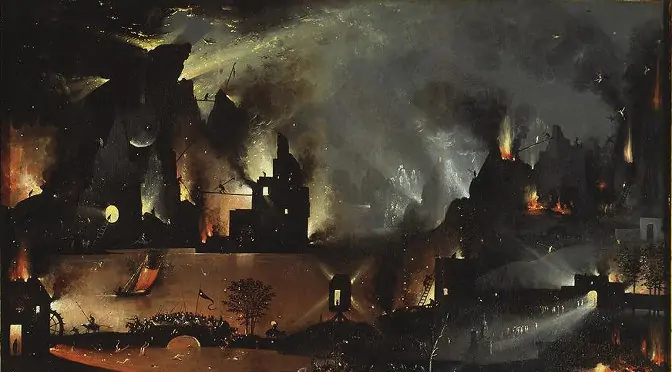
2018 – 2023 EVT – A Polity in Shambles (Mamominarch)

Post updated 10 May 2012. Last weeks’ summary: In 2012 EVT, Everstate (the ideal-type corresponding to our very real countries created to foresee the future of governance and of the modern nation-state) knows a rising dissatisfaction of its population. To face the various difficulties and widespread discontent, in a first scenario, Everstate’s governing bodies implement the Mamominarch programme of drastic reduction of state’s spending over five years through devolution, privatisation and outsourcing. By 2018 EVT, besides a generalised rising insecurity for most Everstatans, the now fragile state cannot efficiently manage the complex catastrophes that start hitting Everstate in May. Further pressures and perceptions of the way they are answered lead to radicalisation and polarisation along three lines: local independence with direct membership to the Regional Unionwith now a battle over Trueland – renewal of a strong central Everstate, and, finally, continuing support to the Mamominarch system.

(The reader can click on each picture to see a larger version in a new tab – a navigating map of posts is available to ease reading – Research note at the bottom of the post, including assessed global impact of scenario on development).

As the Renewers ask for the resignation of Everstate’s government and the end of the Mamominarch system, the government is almost ready to give in. It is, indeed, confronted to an intractable situation, without hardly any means of action and thus completely overwhelmed. However, the traditional elite groups cannot accept to see the end of the Mamominarch system, which would also mean the end of their power. As their coercive power is, actually, now truly in the hands of Novstate, they thus start a series of discussions with Novstate’s CEO and its board of directors. The process is eased by the fact that many of the most powerful people in Everstate are also part of Novstate’s board of directors. Their objective of the elite is to convince Novstate to repress as harshly as necessary the Movement for the Renewal of Everstate. The various movements for independence are seen as less of a threat as they are not united and could probably be handled through some measures of autonomy. The international situation seems to be as favourable as possible to endeavour any kind of represssion as the international society is busy with other pressing matters.

The Renewers, strong of the support the IT world grants them, and wary of the old elite groups’ responses, manage to enter the communication’s and IT systems of Novstate and of the old classical parties. They almost instantaneously start spreading records of the discussions held between Novstate and the elite, underlying the violence of the elite groups, which does not fit well with the still pregnant norms of peace, democracy and respect of human rights. Novstate becomes worried to lose its international standing and thus its lucrative contracts. Furthermore, Novstate reflects that it will still sell the same contracts and services to the Renewers, if those are coming to power, as they will have no other choice. Novstate, thus, abandons the old elite groups that brought it to power, and changes its board of directors.

In the meantime, taking advantage of the situation, both domestic and international, the leaders of the Movement for the Independence of Trueland declare independence unilaterally, if a referendum to be organised soon confirms this wish. A few cities follow immediately. The Renewers are taken by surprise and can only bow to the future results of the referendum. Only the Movement for the Independence of the Whole Trueland – the  Continental South-East – not only strongly protests, but also refuses to acknowledge what it considers as treachery and spoliation. Knowing that it cannot count on Novstate, it ends all its contracts with the company and its friends businesses, and decides to start creating its own army and police forces. In the meantime, groups of hastily created militia carry small incursions in the New Trueland territory, burning a house here, stealing weapons from understaffed small police stations there, and declaring each time that they fight for the Whole Trueland and against traitors.

The international society cannot do anything, as it is involved elsewhere. Moreover, it does not want to handle the problem, as its members meet problems that are very similar to those faced by Everstate, although under different guises and at different stages according to the path each country has chosen. The Regional Union, so dependent upon the power of its members on the one hand, having seen its own resources dwindle with the repeated crises, cannot either afford to get involved. It merely acknowledges the decisions taken and hopes for the best.

A low-level intensity conflict settles in the South-East of Everstate, while, elsewhere, the situation of ordinary citizens has not improved, on the contrary. All energies and power had to be used to start reconfiguring the political system, condition sine qua non for a stabilizing situation, as the old system and its offspring, Mamominarch, repeatedly showed their inability to ensure security.

Thus ends the Mamominarch system, while the potential new model of socio-political order that should follow is still only potentially emerging and, hence, unclear. This new system will not only have to tackle the problems that existed in 2012 EVT, but also cope with the aftermath of Mamominarch. The heightened tension, and the uncertainty generated by the political upheaval first, and, second, the novelty, have frightened most economic agents, notably foreigners, and economy is at its worst. Everstate has also to face the loss of part of its territory, related income and resources, while it has to accommodate those Western refugees that were still in the South-East when the latest political turmoil exploded and were thus expelled, as well as all those who did not want to live under the new Independences. In summary, security needs have multiplied and now must be tackled anew.

Compared with what could have happened had other decisions been taken in 2012 EVT, is the aftermath of Mamominarch a too heavy liability that will delay, if not obliterate, any chance to create and implement a new functioning system, or an opportunity, as the old has already been partly discarded?

To start answering this question, let us now examine the second scenario that could have taken place in 2012 EVT, Panglossy.

To be continued….

Further Research

It would be particularly interesting to construct many similar models for other real and ideal-type countries, to map their interactions and assess impacts for the International Society and for any type of Regional Union. The evolution of each country would also influence the international and systemic level. This would allow us anticipating much better various scenarios including variables related to international pressures on the country analysed (here Everstate) and consequences, thus identifying better the cone of plausibility, or assessing other futures on issues of interest.

For example, if we use the Chronicles of Everstate and Mamominarch to evaluate impacts in terms of International Development, then we can deduce what follows. If, in the current and foreseeable global conditions, donour countries embark on a “programme of drastic reduction of state’s spending over five years,” then, in the medium term,

  • Those states will fragilise;
  • A large part of their population will become increasingly vulnerable, with rising malnutrition and generalised adverse impacts on the Human Development Indices, swelling progressively the mass of the global poor.
  • Those countries’ aid and cooperation programmes and related contributions will dwindle, if not disappear, according to cases.
  • In turn, assuming the current system is not changed, all international organisations will be impacted and see a drastic lowering of their budget. More particularly, it will be impossible for affected donour countries to respect pledges; IDA money risks to plummet, as member states contributions will be lowered.
  • All MDGs will consequently be adversely affected.

2018 – 2023 EVT – Escalation (Mamominarch)

Last weeks’ summary: In 2012 EVT, Everstate (the ideal-type corresponding to our very real countries created to foresee the future of governance and of the modern nation-state) knows a rising dissatisfaction of its population. To face the various difficulties and widespread discontent, in a first scenario, Everstate’s governing bodies implement the Mamominarch programme of drastic reduction of state’s spending. By 2018 EVT, the result is involution, with a rising insecurity for most Everstatans. The now fragile state cannot efficiently manage the complex catastrophes that start hitting Everstate in May. As a result, tension rises relatively uniformly while grievances increase heterogeneously. Inability to answer this multiform situation leads to a new political mobilisation, besides the classical old parties, proponents of Mamominarch: movements for local independence and direct membership in the Regional Union, including a powerful Movement for the Independence of the Trueland on the one hand, and a Movement for the Renewal of Everstate on the other.

(The reader can click on each picture to see a larger version in a new tab – a navigating map of posts is available to ease reading).

News of the terrorist attack on Novcybio International abroad, which had first gone viral among Renewers, lead to a sudden awareness that Everstate could be impacted. What if some of the last genetically modified seeds received by Novcybio Everstate for testing that have already been planted include the dangerous gene engineered by the terrorists? How can Everstatans know? What if, one day, terrorists were to conduct such an attack directly in Everstate?

In August, as soon as Novcybio International had become aware of the threat, its security service had immediately acted, while its PR team started a reassuring campaign, explaining that everything was under control, that the police force had recovered the stolen deadly pathogens and that all potentially dangerous seeds had been identified, and most of them traced and recalled. Now, only a few of them are still missing, but Novcybio International headquarters’ security is working hand in hand with its branches and the authorities of the various countries potentially impacted. Unfortunately, Everstate is on the list of those countries. Soon, Everstate’s central government, the local authorities of the Continental South-East and Novcybio Everstate issue a joint statement asserting that the incriminated seeds have been found, that none of them has thus been planted and that they have now been destroyed.

However, investigations carried out by Renewers point out that one month elapsed between the terrorist attack on Novcybio International and the Everstatan joint statement. The Movement thus accuses the involved actors of complacency, which threatens the security of all Everstatans. This, added to the fresh memories all Everstatans have of the way the complex catastrophes of the Spring were mishandled, implies that few Everstatans fully believe the official joint-statement. People ask for evidence and for the resignation of all political actors involved. Rumours start spreading. This is an impact of the degraded legitimacy presiding over Everstate. The local authorities, seeing their authority imperilled and their power threatened, start distancing themselves from the central authorities, accusing them of inefficiency and saying they did not provide all necessary help. They turn to the Regional Union to ask for further test and control of Novcybio Everstate.

They also try to join the Movement for the Independence of the Trueland, arguing that Trueland covers the whole South-East, and not solely its maritime façade. However, the Truelanders’ leaders reject the idea, as they see the Novcybio affair and the continuing rumors as one more reason to distance themselves from the rest of the country, for the security of real Truelanders. The local authorities of the Continental South-East, as their position is directly threatened on the one hand, as they feel rejected and cornered on the other, then become even more virulent than other proponents of the various local movements for independence, while also starting a campaign explaining that the Trueland cannot be divided between a maritime and continental part.

By StMH (Own work), GFDL or CC-BY-SA-3.0-2.5-2.0-1.0, via Wikimedia Commons

One night Novcybio Everstate is burnt to the ground with the test crops planted on its land. Immediately, the Regional Union and various countries appeal to Everstate’s central government to put its house in order, while Novcybio International asks for compensation. When central officers are sent to the site of the arson to investigate, they are denied entry by angry citizens. As they ask for police support, local authorities refuse it, arguing that they will deal with the problem, which does not concern in any way central authorities.

Everstate’s central political authorities should answer to this direct denial of their power by imposing their will, sending the army if need be. However, considering the highly tense situation, they hesitate, afraid of the consequences. Furthermore, Novstate, which provides both some of the police forces of the Continental South-East and many of the Everstatan armed forces, does not favour seeing its men fighting each other.

The new episode of the global financial crisis that starts in October lessens the international political pressure put on Everstate to remedy to its internal disorder. Other countries, as well as the Regional Union, are now focused on other more important matters. For Everstate, the new general break on liquidity that ensues, as the country is still as dependent as ever on international borrowing, means that it must face new difficulties to pay its remaining central civilian and military staff. Local authorities are also impacted, however in various ways according to the situation of each city and region. Everstate does not participate in the international discussions trying to deal with the global financial disorder, except through Novstate, which is present along other powerful private sector’s representatives.

Italian sphere of influence in Turkey according to the agreements of 1917 in Saint-Jean-de-Maurienne by Arthur James Balfour (1848-1930), Public domain, via Wikimedia Commons

When a new conflict starts in the Middle East, Everstate, which used to be an important player in this region, is not even invited to the summits that take place to try bringing back peace. The Renewers then judge that the country is falling apart, has lost a tremendous amount of crucial international influence and is falling prey to parochial problems that not only do not address the initial real challenges and pressures that endanger the lives of all Everstatans, but, on the contrary, aggravate them. The Renewers thus ask for a resignation of Everstate’s government and for the end of the Mamominarch system.

To be continued

2018 – 2023 EVT – From Grievances to Political Mobilisation (Mamominarch)

Last weeks’ summary: In 2012 EVT, Everstate (the ideal-type corresponding to our very real countries created to foresee the future of governance and of the modern nation-state) knows a rising dissatisfaction of its population. To face the various difficulties and widespread discontent, in a first scenario, Everstate’s governing bodies implement the Mamominarch programme of drastic reduction of state spending over five years through devolution, privatisation and outsourcing. By 2018 EVT, the result is involution, with a fragilised governance including and implying the rise of lawlessness domestically, an abandoned mastery over international security, an inefficient economy and, as consequence, a rising insecurity for most Everstatans. The first set of tragic events - a tornadoes outbreak followed by a heat wave – that hits the West of Everstate soon becomes a complex catastrophe with dramatic direct and indirect impacts.

(The reader can click on each picture to see a larger version in a new tab – a navigating map of posts is available to ease reading).

Faced with destruction and a difficult and very slow reconstruction, Westerners are definitely dissatisfied with the way their political authorities, entrusted with the mission to ensure their security, have dealt with the complex catastrophe that befell them. Many are forced to leave as their survival is threatened and start moving towards other areas. However, they nevertheless expect recognition of their hardship, help and solidarity when they arrive somewhere else.

Yet, nothing is organised nationally. The way they are greeted varies greatly according to areas and even towns. In some cities, local authorities engineer emergency support for newcomers in the name of national solidarity, while everything is done to help them find temporary shelter and work. In others, only family network, when they exist, are active, and the refugees are not only ignored, but also rejected as they are seen as swelling the mass of the poor, homeless and unemployed, as potential criminals, as people lowering wages when they end up taking any job to survive. In those areas, as the refugees remind inhabitants of a selfishness they do not want to confront and of problems they want to deny, rejection hardens quickly.

All Everstatans, finally, feel unjustly treated, one way or another, which only feeds grievances. Those multiply as central political authorities do not acknowledge problems, give no recognition, and do nothing in a timely way. The victims are not supported in those areas where they are best welcomed and those who help them are left to their own device and funding, while the central administrative machine and policies continue as if nothing had happened, sometimes thus enhancing difficulties. Elsewhere fear is not assuaged, its roots are not dealt with. Notably, no one wants to face the fact that the refugees have become a disturbing symbol of a dysfunctional and outdated model of socio-political organisation, when so much hope had been invested in the Mamominarch system.

Over the summer, oil prices surge, with some spikes even reaching 200$ a barrel, as a result of renewed international tensions in the Middle East. This trend intensifies the overall situation in Everstate, as for most Everstatans, save the richest and best connected, life becomes increasingly difficult. Indeed, whatever the efforts the people have previously made, the result of their actions to improve or to the least stabilise their life is reduced to naught by the severe disturbance implied by the energy price. As, furthermore, the food produced in Everstate has become suspect – and sometimes rightly so – because of the industrial disasters, many Everstatans feel that they are left with only two bad choices: either starve because they cannot afford imported food, or kill themselves with polluted food.

The legitimacy of the Mamominarch system is now overtly questioned, and all remember that the governing bodies that decided to convene the Mamominarch commission were already facing similar problems, which only contributes to further de-legitimize the system.

The rising tension spreads throughout the whole country. If all have grievances, those accumulated complaints tend to coalesce and join along different fault lines according to areas and groups, because there is not anymore one national situation but many, notably as a result of the devolution  (spatial variations) and of the privatizations (end of the concept and practice of public good). With time, events and a large variety of responses, the conditions have grown to be very diverse.

External observers are surprised when, building on the tension existing in 2012 EVT, then on those that simmered over the past five years of Mamominarch system, and triggered by the recent events, a Movement for the Independence of the Trueland, a region covering the South-East of Everstate (notably the mouth of the river and the seaside), is created and rapidly takes off. The usual inflow of money that used to bring wealth, and, during the last years, release, to the country with tourism is abruptly halted by the complex catastrophe, as tourists fear coming to Everstate. The inhabitants of the seaside area being relatively richer were thought as much calmer and less likely to mobilise politically. But this is without considering the sudden relative deprivation they feel, which is, furthermore, from their point of view, none of their making.  Other small areas, sometimes only cities, follow suit and also start voicing their desire for local independence and direct membership to the Regional Union.

Yet, not all citizens of those areas share the same views, and those who are dissatisfied with the two main political parties, spearheaded by Occupy Everstate, respond by creating a Movement for the Renewal of Everstate, which is soon joined by large parts of the Westerners, by the refugees and many in those towns that put solidarity first. The CEO of Evernet, as reported by international media, decides to join the movement she sees as prefiguring the future. She offers the technical support of Evernet, providing even funding and sometimes directly hardware to the Renewers, as they are soon called, when those cannot afford anymore access to social networks considering the degraded overall situation.

Meanwhile, Novstate and its friends companies make sure they remain officially neutral, offering their services to all, while they continue promoting the system that made their fortune.

Many of those joining the new Movements did not belong, previously, to any political party. They had even often abstained during previous elections. Yet, the two main parties, the conservative and the social-democrat, with still their headquarters in the capital, start losing sympathisers. The classical elite groups remain faithful to the two traditional parties, which have created the Mamominarch system, and start worrying about the evolution of the situation. First, the Western quagmire has marred the international ideological standing of the Mamominarch system, which seriously limits the opportunities offered to the elite.

Then, those new Movements imply a loss of power for the two parties that constitute the usual political framework of the elite, indeed the way its members think and live. The elite groups initially try to dismiss the new Movements because they do not enter the familiar right/left, conservative/social-democrat way to think and thus, certainly, do not correspond to anything serious… yet the political mobilisation is there, as well as the grievances and the tension and altogether they completely deny everything the elite has ever believed in and stood for. The new Movements have not even tried to include them.

The Renewers then pick up on a report according to which a terrorist group has infiltrated a Novcybio laboratory in its home country a few weeks ago, stolen some deadly pathogens and manipulated others, mixing them with some of the genes experimented. Considering the existence of Novcybio Everstate, the news goes viral through social networks, among Renewers initially.

To be continued

2018 – 2023 EVT – Complex Catastrophes (Mamominarch)

Last weeks’ summary: In 2012 EVT, Everstate (the ideal-type corresponding to our very real countries created to foresee the future of governance and of the modern nation-state) knows a rising dissatisfaction of its population. To face the various difficulties and widespread discontent, in a first scenario, Everstate’s governing bodies implement as policies the conclusions of the Mamominarch Commissiona programme of drastic reduction of state spending over five years through devolution, privatisation and outsourcing. By 2018 EVT,  the result is involution, with a fragilised governance including and implying the rise of lawlessness domestically, an abandoned mastery over international security, an inefficient economy and, as consequence, a rising insecurity for most Everstatans. A series of tragic events then strike Everstate.

(The reader can click on each picture to see a larger version in a new tab – a navigating map of posts is available to ease reading).

The tornadoes outbreak that hits the Western part of Everstate in May, as well as the other tragic events of the year, results of global pressures accumulated over the years, including in terms of ecological setting.*

Two of those tornadoes  are deadly. They are rated EF5 on the Enhanced Fujita Scale and have a very long track reaching almost 70km.

Hundreds of power transmission towers are taken down, and, as a result, electricity outage occurs in a large part of Everstate’s West.** The scope of civilian disaster is huge. So much of the population is hit. To the fatalities, casualties and people unaccounted for, must be added people finding themselves overnight without shelter. Furthermore, as all communications are severed, evaluation and first emergency is terribly difficult. The tornadoes also hit two industrial sites in this recently industrialised part of Everstate. A corner of the dam of a reservoir containing liquid waste collapses, releasing toxic muds. First, the wave of mud reaches a nearby small town, miraculously spared by the tornadoes and then spills inexorably to reach the Everstatan main river.***

Not far from there, one of the storages of an agrochemical company is ground to pieces. Highly toxic levels of pesticides are released in the air.****

Panic presides to the outbreak and to the first days. Then comes the extreme difficulty of dealing with “complex catastrophes.” In the words of Paul N. Stockton, the assistant Secretary of Defense for Homeland Defense and Americas’ Security Affairs,

“Complex catastrophes differ from normal disasters in two ways. First, the scale of destruction is vastly greater… Second,… complex catastrophes may create cascading, region-wide failures of critical infrastructure, starting with the disruption of the commercial electric power grid….This loss of power could create cascading effects on communications and other critical infrastructure. From a public safety perspective, the most immediate concern might be the impact on municipal water systems, ..  Transportation infrastructure could be degraded as well; gas and diesel fuel pumps, for example, depend on electric power to function. While many hospitals and other facilities critical to disaster response efforts have backup diesel-powered generators, we anticipate few will have sufficient fuel on hand to offset power outage lasting weeks to months, and that companies responsible for resupplying them could face a radical mismatch between supply and demand.” in Stockton, ”Ten Years After 9/11: Challenges for the Decade to Come,” Homeland Security Affairs, Volume 7, The 9/11 Essays (September 2011).*****


Locally, as the Western areas have never known any natural catastrophe, are not located in a seismic zone, and are not considered as sensitive defense-wise, no preparedness for any natural or even man-made emergency exists.

Novstate, which is contracted for the management of crisis and emergency response nationally, should have had at least the beginning of an emergency plan ready, and should start implementing it. However, it is without counting with a few crucial factors. First, the electricity outage considerably slows and delays all communications, evaluations, transport and logistics, while rapidly increasing hazards to the population as hospitals, notably, will soon run out of fuel for their backup diesel-powered generators. Second, Novstate has not planned for any type of such multi-risk emergencies spreading on large areas, both urban and rural. It has mainly focused on terrorist attacks in the major Everstatan cities. Finally, the involvement of many different companies responsible for so many types of infrastructures, including hospitals, and in charge of various outsourced services creates a highly complex picture of independent intervening actors that have to be identified, organised, and put to work on an emergency, solidarity and not for-profit basis. Furthermore, Novstate’s mandate includes no specific authority to act in such a way. Meanwhile, the political authorities who do have this legitimacy have now to do with a reduced Everstatan central administrative staff, soon overwhelmed by a catastrophe of a type and scale never envisioned.

Finally, after 4 days, prompted by international calls from his counterparts and from the Regional Union, Everstate’s Prime Minister finally asks for international help. Meanwhile, thousands of Everstatans lost their lives; the Everstatan main river has become severely polluted, toxic mud spreading towards the agricultural South and the touristic mouth of the river. The toxic dust has spread with the very strong winds and the full extent of damages will only be discovered with time, but have created health hazards for human beings, biodiversity and most probably impacted soil and water.

Again, the initial absence of overall coordination runs contrary to the efficiency of the assistance, and the Regional Union, incorporating in the lead team Everstatan regional civil servants to respect Everstate’s sovereignty and the Novstate executive responsible for emergencies, has to firmly take over.

Thanks to international help, the crisis is finally contained, but it takes a few months before such services as electricity, which were previously taken for granted, are fully reestablished. Worse damages such as epidemics are avoided. Yet, the terrible environmental impacts are there.  Furthermore, the drought that follows dries up the river helping spread the toxic mud changed in dust over even larger areas of the country.

The Everstatan quagmire has highlighted the high difficulty of complex catastrophes’  management and intervention, notably in a context of privatised infrastructures and outsourcing. It is reviewed and criticised internationally by multiple instances. As a result, Everstate’s model begins to be seriously questioned, which has indirect negative effects on the export of services, as the Everstatan Mamominarch-type of knowledge and skills is now considered as inadequate. Yet, Novstate manages to turn the tragedy to its advantage, and can now sell its unique expertise.

The overall direct and indirect cost of the tornadoes outbreak is very high. Security has definitely not been ensured and, seeing the slow rate of reconstruction, the absence of hope of much help considering the already overall difficult situation of Everstate before the tornadoes, Western refugees start moving towards other areas.

To be continued

——-

* According to Munich-Re, “A sequence of devastating earthquakes and a large number of weather-related catastrophes made 2011 the costliest year ever in terms of natural catastrophe losses….With some 820 loss-relevant events, the figures for 2011 were in line with the average of the last ten years. 90% of the recorded natural catastrophes were weather-related – however, nearly two-thirds of economic losses and about half the insured losses stemmed from geophysical events, principally from the large earthquakes. Normally, it is the weather-related natural catastrophes that are the dominant loss drivers.” Munich-Re, “Review of Natural Catastrophes in 2011,” 4 January 2012. Download pdf.

** The video was published on Nov 17, 2011 by AssociatedPress and posted on YouTube: “A tornado ravaged three neighborhoods in the outskirts of the Bolivian city of Cochabamba, damaging dozens of private homes and warehouses but was not responsible for any deaths. (Nov. 17).” For a recent example of a very destructive tornadoes outbreak, see the U.S. 2011 Super Outbreak, which occurred from April 25 to 28, 2011.

*** Inspiration for this part comes from the Ajka alumina plant accident in Hungary (4 October 2010) – The video on YouTube ”VÖRÖSISZAP” – “RED SLUDGE” was uploaded by  on Oct 14, 2010.

**** The idea came from the sadly famous Bophal disaster in India (2–3 December 1984). Watch “Seconds From Disaster – Bhopal nightmare [Full Episode 45:05],” National Geographic Channel.

***** Stockton also emphasises that local authorities would need to ask for (in the case of the U.S., federal) help.

“Responding to those requests in a timely manner could create complex challenges for the department [of defense] in sourcing the requested capabilities, transporting them, and then providing for their reception, staging, onward movement, and integration in a severely disrupted environment.”

2013 – 2018 EVT – Involution (Mamominarch)

Last weeks’ summary: In 2012 EVT, Everstate (the ideal-type corresponding to our very real countries created to foresee the future of governance and of the modern nation-state) knows a rising dissatisfaction of its population. To face the various difficulties and widespread discontent, in a first scenario, Everstate’s governing bodies implement as policies the conclusions of the Mamominarch Commissiona programme of drastic reduction of public expenses over five years through devolution, privatisation and outsourcing. By 2018 EVT, the policies do not lead to a current account surplus as expected nor to a reimbursement of public debt but to a rising current account deficit as well as to the withering away of the nation’s income.

(The reader can click on each picture to see a larger version in a new tab – a navigating map of posts is available to ease reading – research note at the bottom of the post).

The withering away of the nation’s income would imply, under a system other than Mamominarch (minimization of state’s spending as core principle), an acknowledgement of the need for new resources and income. Here, however, considering the core beliefs upheld, this is impossible. Yet, taxes still exist, including the new, temporary ones decided back in 2012 EVT. Those should allow bridging the gap until the budget situation becomes balanced again and a large part of overseas debts is reimbursed. Now, as the overall income of the nation shrinks (added to other linked factors) and as no new resources are looked for, the overall level of resources extracted decreases, despite the 2012 EVT supplementary taxes. This, in turn, does not lead to a balanced budget as hoped, but to a renewed deficit, although smaller. Meanwhile, debts cannot be reimbursed.

Going on trying to balance the budget through the Mamominarch system will only lead to a regressive spiral of further reductions of state’s expenses, which, in turn, will mean less income for the nation, which will imply further slahes in state’s expenditures, etc.

The shrinking of the income of Everstate as a nation also impacts the power of the ruler, i.e. the nation and its governing bodies. This weakens, unsurprisingly, the bargaining position of the ruler regarding the elite and the strength of the central order. Those impacts are in line with the Mamominarch system, which promotes privatization and outsourcing on the one hand, devolution, on the other.

Another factor seriously undermines the power of the nation and of its governing institutions: the dissolution of the legitimate monopoly of violence. First, outsourcing spreads when external military pressures and threats do not relent. Meanwhile, outsourcing  added to an ever weakening central order and power means less control over the way threats are perceived, monitored, labeled and faced, while the entities perceiving, monitoring, labeling and acting on the threats are driven by profit and not by national interests.

Then, local criminality and organised crime are on the rise. In the poorest areas of Everstate, the minimal level of local public funds makes it difficult to hire the police force necessary to face rising difficulties, and impossible for private contractors to take over as benefits would be too low. Nationally, despite Novstate’s central database and communication system, the delocalisation of police force and the use of multiple private contractors makes it extremely complex to follow, analyse and understand flexible criminal organisations used to take advantage of weaknesses of central power, while coordinated action is even more difficult. As a result, spreading pockets of lawlessness develop, while Everstatans start experiencing very different lives according to  where they live.

Finally, the withering away of the nation’s income impacts Everstate’s governance.

True enough, devolution, increased reliance on the Regional Union and management by the private sector were meant to compensate such probable impacts. However, as seen, things did not work this way on the whole territory and governance increasingly becomes fragile, and less efficient.

As further example, the sudden inflow of capital and arrival of highly paid foreign executives at the beginning of the Mamominarch period led to a sharp increase in real estate prices in those areas favoured by foreign investors. As it had not been anticipated, and as, anyway, it favoured real estate owners, notably elite groups, it was considered as positive. Yet, the real estate boom also created a difficult situation for local people, as wages remained frozen considering the otherwise uncertain and even negative global context. In those cities, areas and villages where the real estate boom occurred and where prices still remain very high, demonstrations and protests take place.Yet, they are never of a national scope – as different places are impacted differently – and rarely mentioned beyond local news. Those responsible for local governments do not either report them to central authorities as, anyway, at national level, there is no one in charge of this problem anymore. Each locality deals with the problem solely according to its own idiosyncrasies, and with its own resources, which impairs the implementation of sustainable solutions.

In those areas of the East and South, which have not attracted foreign investment, unemployment rises, poverty and inequality increase and a feeling of injustice deepens and spreads. Yet, these provinces used to be rich as they were those where agriculture had traditionally been done. But now, even rising food prices do not allow smaller exploitations to live properly considering the surging cost of life, notably generated by unmitigated new resources’ conditions. Left to their own device, without any help from local administrations too poor to do anything, people migrate away to richer areas, where they are used as cheaper labour. As the situation is far from full employment, they generate hostile feelings from the indigenous populations who cannot compete. Completely new tensions, declined in nationalistic terms, start appearing, when none existed previously.

Meanwhile, some wealthy Everstatian entrepreneurs start buying land in those areas at a very low price. For example, one of them is contracted by a foreign company, Novcybio, which develops new biotechnologies, to test its products on his land for a high premium.

Everstate’s economy has grown very inefficient for the vast majority of Everstatans. The security provided to Everstatans has not only not been improved but, on the contrary, is degrading.

We are thus back to dynamics similar to those existing in 2012 EVT, before the Mamominarch Commission, but to those must now be added the unintended unfavourable  impacts specific to the Mamominarch system.

This is when tragic events strike.

To be continued

———-

Further research

As we progress in the scenario, it becomes obvious that the initial model could be improved along at least two lines:

  1. As noted initially, if the model was computerised, we should be able to truly follow dynamically, time segment by time segment, the evolution of the situation. Here, because of the absence of such a computerised power as well as for the sake of narration, we have to take a much less detailed approach and to synthesise it by broad themes. This leads us to reflect upon the way we are used to organise and present our thoughts, more according to categories than to dynamic processes, and that could, in itself be an impediment to a proper handling of transition situations, when “everything seem to happen at once.” Research on other ways to present situations, that would nevertheless be appealing and cognitively understandable could be rewarding.
  2. Recalling the difficult problem of levels of analysis, as identified by Waltz (1959), it would be interesting to develop also the model on different layers, i.e. global, regional, central and national, local, according to the various existing layers of governance.

Kenneth Waltz, Man, the state, and war: a theoretical analysis, New-York: Columbia University Press, 1959.

2013 – 2018 EVT – A Current Account Surplus? Think again! (Mamominarch)

Last weeks’ summary: In 2012 EVT, Everstate (the ideal-type corresponding to our very real countries created to foresee the future of governance and of the modern nation-state) knows a rising dissatisfaction of its population. To face the various difficulties and widespread discontent, in a first scenario, Everstate’s governing bodies have transformed the conclusions of the Mamominarch Commission into policies. They have thus started implementing the programme of drastic reduction of public expenses through privatization and outsourcing, transfer of responsibilities to local administrations and increased reliance on The Regional Union, accompanied by a temporary increase in income and consumption taxes. The first months of reforms have been successful and the situation appears to improve.

(The reader can click on each picture to see a larger version in a new tab – a navigating map of posts is available to ease reading – research note at the bottom of the post).

trade exports s3

Everstate’s capacity to reimburse its debt should also come from a positive current account, fed, in part, by a positive trade balance, aggregating results in trade of services and trade of goods.

Trade balance (1)

Initially, the well-educated population and the disappearance of many positions of civil servants leads to an abundance of expert personnel. Through Novstate and its friends companies, benefiting from the positive perception the reforms undertaken in Everstate generate, the export of services skyrockets.

However, with time, it is becoming increasingly difficult to send children to school. The provinces have now to manage the education system alone or with the private sector, and the latter sees no immediate interest in funding primary or high schools.  Private schooling becomes the norm, and  weights heavily on the budget of the less well-off.

If the best-known universities find some funding with the new inflow of capital, this is restricted to specific branches, namely finance, economics, some areas of politics, war strategy and tactics thanks to Novstate, IT and some technologies of direct interest to the companies having invested in Everstate. As a result, research greatly suffers. To compensate the absence of public funding, universities triple their fees and only the most fortunate families can now send their children to universities. Scholarships almost disappear. The banks are not interested anymore in lending to students as the benefits are too small and as students, most often, have no guarantor. Local administrations send reports on this dreadful evolution to Everstate’s national representatives and to the central government, but the latter can only try to compensate through its yearly orientation paper, which has close to no effect as it is not assorted of any possibility of action. Hence, the number of well-educated and internationally competitive Everstatans rapidly dwindles.  Furthermore, those who could receive graduate and post-graduate education are trained exclusively in those approaches at one with the Mamominarch system. Hence, as time goes by, if ever the Mamominarch system is not proving to be the ideal solution expected, will they still be considered as adequate?

After the first months of euphoria and hope following the implementation of the Mamominarch policies, the educated youth finds itself in the same conundrum as previously, but with even less prospects. If new qualified jobs are created by the foreign and domestic companies investing in Everstate and by the new outsourcing contracts, those are given in priority to ex civil servants and to foreigners. As a result, already by the second half of 2013 EVT, except in the IT sector focused on online shopping and electronic payments, most young graduates and post graduates find themselves still unemployed or under-employed, taking whatever jobs they find in tourism or industry. At the beginning of the period, those with the best academic records, and who can afford it, try to migrate, but, considering the still uncertain global situation, few succeed. By 2018 EVT, the relative position of the Everstatan educative system is such that, added to the failure of their elders to escape, hardly any smart young Everstatan still tries migrating.

Overall, the export of services cannot grow anymore.

As far as the export (and import) of goods is concerned, those depends not only on human skills and workforce but also on available resources. Now, as seen, with the exception of the tourism industry, Everstate has to face domestic shortage or sharp increase in prices  (stemming among other causes of a relative decline in supply) for the resources it used to transform and to include in the goods it exports.

Furthermore, many of those resources – classical and new – needed by Everstatan producers  are not located on Everstatan territory. For example, for many high-tech companies, rare earth elements are a crucial industrial component.* However, those rare earth deposits are not present everywhere and in the same quantity, China being, currently, the lead producer.

This new condition regarding resources, as explained previously, should imply increasing tasks in governing, which, themselves, demand new resources and income for the ruler and its staff (including the need for new staff).   This, in turn, would mean further and new state spending, at least until the system is stabilised. However, as supplementary state expenditures are ruled out by the Mamominarch system, then the search for new resources and income cannot even be thought and thus novel strategies of extraction of resources can even less be identified. Thus, the increasing tasks of governing can be neither planned nor carried out. Worse still, the dismantling of so many services of the state makes it impossible to monitor, record and analyse what is happening.

As, worldwide, so many industries are competing for the same resources, national policies and negotiations are more than helpful, they are necessary. However, in Everstate, businesses cannot anymore benefit from such support and each company with supply problems must fend for itself. Each is now alone to find solutions, or it must turn to the Regional Union or to International institutions or try to find other private allies, which, in a world of hardened competition, may be hazardous. Meanwhile, other companies from other countries do benefit from their government’s support. Everstatans businesses thus find themselves at a competitive disadvantage. Indeed, relatively quickly, the young Everstatan industries dealing with those materials involving rare earth elements, for example, lose to competition. Either they go bankrupt or, when their technology is interesting, they are bought by foreign companies, which then re-localise according to their own priorities. By 2018 EVT, no Everstatan industry involving rare earth elements remain.

The situation regarding energy is similar, however with even worse consequences… to be continued.

————

* Among others, for interesting estimates on the whole rare earth element market, see the analyses made by the South African company frontier Rare Earth, as well as their sources. For an example of use,  see articles on the electric car and corresponding batteries (although the importance and scarcity of Lithium for Lithium-ion batteries is disputed) e.g. David Biello, “New Energy-Dense Battery Could Enable Long-Distance Electric Cars: Material changes enable a new battery to store more electricity–and could boost the driving range of electric vehicles,” Scientific American, February 27, 2012; Shane McGlaun, “Science Researchers Create Fluoride Battery, Look to Replace Lithium-ion Technology,” Daily Tech (Blog), October 24, 2011.

——-

Further research

As underlined in the previous post, ideally, with more resources, notably a team of researchers and adequate computing facilities, the values attributed to variables should be quantified, when the variables are about quantities.  Notably, it would be very interesting, assuming we were able to enter specific times for each link, to test the variation of those time periods according to changes in quantities, and vice versa. It is indeed possible – or even likely – that thresholds and tipping points may occur according to such variations. More broadly, such hypotheses could also be tested on qualitative variables, methodology to be defined.

2012-2013 EVT – Implementing the Mamominarch conclusions

Last weeks’ summary: In 2012 EVT, Everstate (the ideal-type corresponding to our very real countries created to foresee the future of governance and of the modern nation-state) knows a rising dissatisfaction of its population. To face the various difficulties and widespread discontent, Everstate’s governing authorities decide to follow the conclusions of the Mamominarch Commission that recommend to drastically reduce state expenditures.

(The reader can click on each picture to see a larger version in a new tab – a navigating map of posts is available to ease reading – methodological or research note at the bottom of the post).

The Mamominarch conclusions become policy

All governing bodies thus adopt the conclusions of the Mamominarch Commission. New laws are enacted when needed, which is easily done as the major parties seating in Parliament were part of the Commission. The constitution is even changed to incorporate the new ideals and objectives. As top-level civil servants were also either part of the Commission or represented, legislation can be executed without any major impediment. Indeed, a mix of career and organisation related incentives*, as well as normative material and ideological stakes greatly facilitate execution at all levels.

As the major elite groups, including the lenders, were also present, no elite-prompted hidden opposition exists; liquidity and the various resources mastered by the elite, including the traditional mass media, are largely made available. International and Regional support by those organisations that were included in the Commission is strongly emphasised through various diplomatic gains and prestige attention. A few more  Everstatan officials and political figures obtain high level positions in various international fora.

Papers, articles, interviews and books from the various experts, famous people, and academics having been part of the Mamominarch Commission soon reinforce mass media support. “The Mamominarch break-through: reinventing true happiness” written by Novstate’s CEO and founder becomes an international best-seller, while Hollywood starts the production of the next blockbuster on the life-story of the successful businessman.**

As the new measures are heralded as the new type of governance adapted to the reality of Everstate and allowing for a happy future, in line with the worldview and its beliefs, citizens find back meaning and hope and accept the new laws and policies, although with some worries regarding the efforts they will have to consent. A few remain skeptics but their voices are muted by the majority and by the normative deluge of support to the new system. The unions hope that renewed growth will stop unemployment.

As a result, the Occupy Everstate movement loses many of its sympathisers. Furthermore, as the Mamominarch system means less state, the part of the movement that tends to embrace anarchism is satisfied. The presence of Evernet’s CEO within the Commission quells some of the fears regarding over-regulation of the Internet and online networking. Occupy Everstate tends thus to lose even more active supporters and apparently recedes. Its most active members can do nothing else than going back home. Yet, the links between them, notably through social networking are not severed.

Remains now to engineer the reforms and notably the delicate short-term transition.

Implementing the Mamominarch policies 

state and ruler expenditures s3

The variable upon which the Mamominarch Commission plays is “ruler and state spending” (see below methodological and research note).

The drastic reduction of expenses will reduce the deficit, stop borrowing and thus stabilise the interests, notably those paid abroad as a large amount of the debt is held overseas. However, the existing debt must also be reimbursed. This should be made possible overtime and as quickly as possible, notably with a positive current account.

First, Everstate must organise a temporary increase of resources extracted to meet the existing expenses, waiting for those to disappear or be significantly reduced. It must do so without impacting either the lenders’ nexus or the elite groups. However, as the overall situation has not yet changed (see 2012 EVT: Budget Deficit and Liquidity), the only way, as recommended by the Commission, is to sensibly increase taxes on personal income and on consumption, the latter being favoured as it is said to be less felt by citizens. To underline the temporary character of the effort a special contribution is created, “the salvation tax,” which will affect all tax payers incrementally and progressively and is perceived on all incomes (rate between 8% and 12%), will be paid as soon as 2013 EVT. Meanwhile a new tax on consumption of 3% on top of the existing ones, “the anti-debt tax” is applied immediately. Those taxes will be suppressed in five years.

The drastic reduction of public expenses is planned over a five-year period. All public services related to infrastructure will be decentralised and sold to the private sector within the next six to twelve months. All heath care related activities, and the whole pensions and retirement sector will similarly be privatized over the next two years. By 2017, aiming at  reducing the central civil service by 50%, whole sections of ministries will be priced and then sold, if the mission of the unit is seen as economically viable and better externalised, or transferred to a local administration. Services will then be paid either by the state or local administration through contracts following the outsourcing method, or directly by people, according to cases. Within the central state administration, the management of outsourcing is reinforced on an interagency or interministerial basis, while exchanges with The Regional Union for analysis and direction are increased. The education and university systems are considerably privatised and localised; Everstate, working hand in hand with the Regional Union, will keep only a mission of orientation and accreditation.***

With cuts equally divided in 5 steps, one per year, the foreign and diplomatic services, defense, intelligence and police budget are further reduced. Most operations of cooperation and aid will be the responsibilities of volunteer organisations and private firms within the year. Only the bare minimum of diplomatic presence will be kept, while analysis increasingly will rely on both private contractors and The Regional Union. The army will be further reduced across all functions, with a staggering increase in the use of private contractors, mainly operated by Novstate. The new cyber-division that was about to be created is contracted to a Novstate’s friend company. Police forces become localised and use of outsourcing through private security companies must become the norm. Novstate offers a centralised access to information and communication, besides operating many local police posts.

Within a year, state expenditures are already strongly reduced, but not sufficiently. As hoped, Everstate is upheld as model for having so efficiently and swiftly solved the problems that plague so many countries. The debt has been reduced through the flow of money generated by the privatizations. Income, notably taxes, is still insufficient to pay for  expenses, but the deficit is on its way to be reduced.

The success and the favourable environment attracts foreign capital, notably new banks, insurances and financial institutions developing new products, as well as foreign companies taking over some of the state services of Everstate, when those are not provided by Novstate and its friends companies. They mainly settle in Everstate’s capital. Foreign capital is also very active in allowing for the privatization of Everstate’s state infrastructure. CEOs, who think it would be more interesting for them to produce part of their goods in the Western provinces of Everstate, start building factories and hire local people. Meanwhile, medium to high-end tourism, notably in the snowy and mountainous North and on the coastal areas, is flourishing. Interestingly, the seaside area also attracts internet companies specialised in online shopping and electronic payments.

Unemployment, by mid-2013 EVT seems to be stabilised, even if it is not reduced. However, the brutal change of system has introduced a rampant fear, yet compounded by hope, in Everstatans as they see their income reduced and have to adapt to the new healthcare, pension system and to the whole new now privatized services. The answer to fear is a new harshness and selfishness in social relationships as each compete to try to earn more.

After those years of worry and stagnation, a real boom is starting to appear possible for Everstate, and its growth rate, although still low, is above those of its neighbours.

To be continued

* See for an example of the way those incentives can interact, Nolan, Janne E., and MacEachin, Douglas, with Kristine Tockman, Discourse, Dissent and Strategic Surprise Formulating U.S. Security Policy in an Age of Uncertainty. Washington, D.C.: Georgetown University, Institute for the Study of Diplomacy, 2007; Chester A. Crocker, “Thirteen Reflections on Strategic Surprise,” Georgetown University, 2007.

** For dynamics between national security issues and apparatus and the movie industry, see Jean-Michel Valantin, Hollywood, the Pentagon and Washington. Anthem Press, 2005.

*** Some countries within the OECD are currently downsizing their civil service sector and  using privatization, with noticeable variations according to countries, see, for a study on the EU members, Forward Planning and International Affairs Bureau (B2), General, Directorate for Public Administration and the Civil Service, “Administration and the Civil Service in the EU 27 Member States: 27 country profiles” Republique Francaise, MINISTÈRE DU BUDGET, DES COMPTES PUBLICS ET DE LA FONCTION PUBLIQUE, 2008. With the 2010-2011 renewal of the crisis, downsizing in the public sector has increased, as for example, in the UKgovernment statistics on civil service employment since 1902. However, compared with the scenario used here, those changes have been or are  implanted over longer periods of time. For example, in Austria “The number of federal administration employees has fallen from 300,000 in 1985 to 133,000 at present” (2008). Further research on variations in the speed of the reforms and their impact would need to be undertaken.

——-

Methodological and research note

Working backward with ego networks

The method remains to use ego networks as previously. However, the model has been created in a forward manner, using existing work on state-building that takes as assumption an increase in needs and resources. Here the decisions taken in the scenario answer to a slightly different logic, as underlined in the previous post: they do not consider needs or state-building, but only a reduction of expenses.
We shall thus, in terms of ego network, sometimes have to work backwards, following the arrows from target to source to identify the value the source node could have, given the value attributed to the target node (this may also be seen as a variation on the method known as backcasting.)

Further research

Ideally, with more resources, notably a team of researchers, the values attributed to variables should be quantified, when the variables are about quantities. This will become even more obvious with the next posts.  Notably, it would be very interesting, assuming we were able to enter specific times for each link, to test the variation of those time periods according to changes in quantities, and vice versa. It is indeed possible – or even likely – that thresholds and tipping points may occur according to such variations. More broadly, such hypothesis could also be tested on qualitative variables, methodology to be defined.

2012 EVT – Scenario 1 – Mamominarch: Off with the State

Last weeks’ summary: In 2012 EVT, Everstate (the ideal-type corresponding to our very real countries created to foresee the future of governance and of the modern nation-state) knows a rising dissatisfaction of its population. Plagued with a deepening budget deficit and an increasing need for liquidity, a related creeping appropriation of resources while the strength of central public power weakens to the profit of various elite groups and with an outdated worldview that promotes misunderstanding, disconnect and thus inadequate actions, the political authorities are increasingly unable to deliver the security citizens seek and risks to the legitimacy of the whole system increases. Alarmed by the rising difficulties and widespread discontent, the governing authorities decide to do something. Three potential scenarios or stories will be told: “Mamominarch: Off with the State,” “Panglossy: Same Old, Same Old,” and “Genuisy: the Making of History.”

(The reader can click on each picture to see a larger version in a new tab – a navigating map of posts is available to ease reading).

The Mamominarch Commission

Considering the difficulty of the problems at hand, and the need for a consensus among powerful elite groups, as well as regional and international actors, to see the array of measures applied, once they would be identified, Everstate’s government convenes a high level commission that must find out what has to be done.

The highest level of the government thus hand-picks to participate in the work: high level government and state officials, the latter representing civil servants, parliamentary representatives of the major parties, who had been in power alternatively for the last seven decades, famous economists Everstatan and foreign, the director of the Everstatan School of Liberal Politics, management experts, business leaders, notably the CEOs of Novstate and its friends companies, the CEOs of the largest banks and largest financial funds, business consultants, experts in new technologies, high level officials of the IMF and WTO and of the Regional Union. All powerfully stand for the normative order to which Everstate belongs and for the major entrenched elite groups. As an exception to this rule, the CEO of a very performing high-tech Everstatan company, Evernet, is also invited to represent the emerging elite group related to computing and networking.

After two months of intense debates and work, most often done by the staff of those personalities that participate in the high level working group, the Mamominarch Commission, as it is now known, reaches the conclusion that the root cause of the problems is an impossibility to match public expenses with public income, even in times of economic growth, and thus that the obvious solution is to drastically lower public expenses.

Structure of general government expenditures 2008 (OECD 2010)

Of course, this solution is designed in terms of expenses and not of needs, but is it really a problem? The normative model of the time, which has been just so successful into bringing wealth and growth, upholds free entrepreneurship, free trade and free market as ideal. Meanwhile, the state and especially its bureaucracy tend to be seen as expensive and inefficient, obviously unable to adapt to the new conditions as the deteriorating situation proves, and furthermore unable to contribute to ensure its primary mission, the security of its population as, again, the protests and the increasing tension shows. It thus makes complete sense to push the normative order one step further and to finally apply it fully: to rely on free entrepreneurial forces and on the market to provide for goods and services as much as possible, to always work in this direction, while the state must wither away. After a short period of adaptation everyone will be happy and definitely better off as balance will have been restored and this time permanently.

What will be more delicate to engineer is the short-term future, when further efforts in terms of income will be asked from the population, as existing debts must be reimbursed and interests paid. But, the difficulties will only exist for a very short period of time, as the renewed growth will rapidly make the effort painless.

Some civil servants will have to be laid off but as services will be taken over by the private sector, they will certainly find work again very rapidly, on the model of Novstate. Such a move may even enhance their career, as the economy will certainly be greatly boosted by this new system.

The Shadow Banking System, Conceptualized, designed and created by Zoltan Pozsar, The Federal Reserve Bank of New York, November, 2009

Furthermore, selling whole parts of the state, as has already been started, will bring in more money that will be used to reimburse debts, thus helping stabilise taxes. There will be no need to find really new taxes, except, maybe, for a short period of time, and especially no need to truly start thinking about ways to make the lenders’ nexus pay more tax – which is, anyway, something really difficult to craft as the whole financial system has become so complex, and would ask for international treaties, which would demand too long to obtain, assuming it were possible.*

Finally, as many members of the Commission underline, this will be good for business, attract investment, and put Everstate in rank to compete with the top financial and businesses orientated places in the world.

Only a minimum army and police will remain at state level. Most of the police force will now be under the responsibility of local towns, as, anyway, criminality has to be solved by proximity actions, on the ground, and through a better understanding of criminals. Operations against existing national threats will be shared between what remains of the defence forces, with a rising use of private contractors. Novstate’s CEO has pledged during the debates that his company and its friends businesses would do their utmost to fulfill any need Everstate would have in this matter.

PR, communication and advertisement specialists, as well as lobbyists, are now brought in to make sure that the conclusions and message of the Mamominarch Commission are delivered at best so that they become policy decisions adopted by Everstate’s governing bodies.

Everything goes indeed very smoothly and all Mamominarch’s conclusions are adopted.

To be continued

——

References

Zoltan Pozsar, Tobias Adrian, Adam Ashcraft, and Hayley Boesky, Shadow Banking, Federal Reserve Bank of New York Staff Reports, no. 458, July 2010; “According to one measure of the size of the shadow banking system, it grew rapidly before the crisis, from an estimated $27 trillion in 2002 to $60 trillion in 2007, and remained at around the same level in 2010.” Financial Stability Board (FSB), Shadow Banking: Strengthening Oversight and Regulation, October 2011, p.1;  Brook Masters (2011-10-27). “Shadow banking surpasses pre-crisis level”The Financial Times. accessed 2012-02-10.