A Beautiful Timeline Visualisation: TimelineJS by VéritéCo

Last week, as I was looking for good websites and twitter users to follow the students’ movement in Quebec, its support by and links to the other worldwide opposition movements, and to try to assess how it could evolve, I found this really useful, informative and beautiful website displaying a timeline of the events done by Xavier K. Richard, @xkr.

Today, I found that this timeline, or rather the incredible tool to make such a timeline, TimelineJS, created by VéritéCo, is a free web-based application. I could not resist the temptation to try it, continuing on the series of timelines created for “the Tragic Events that strike Everstate.” It is truly very easy to use (just use the Google spreadsheet template provided on the website, and enter your data instead of those given as example), then follow the directions given on the TimelineJS website and, finally, embed it on your website. You can include videos and photographs, and, compared with the two others that were previously tried, you can create as many timelines as you want, which is a great advantage.

Here is the result:

2018 – 2023 EVT – Escalation (Mamominarch)

Last weeks’ summary: In 2012 EVT, Everstate (the ideal-type corresponding to our very real countries created to foresee the future of governance and of the modern nation-state) knows a rising dissatisfaction of its population. To face the various difficulties and widespread discontent, in a first scenario, Everstate’s governing bodies implement the Mamominarch programme of drastic reduction of state’s spending. By 2018 EVT, the result is involution, with a rising insecurity for most Everstatans. The now fragile state cannot efficiently manage the complex catastrophes that start hitting Everstate in May. As a result, tension rises relatively uniformly while grievances increase heterogeneously. Inability to answer this multiform situation leads to a new political mobilisation, besides the classical old parties, proponents of Mamominarch: movements for local independence and direct membership in the Regional Union, including a powerful Movement for the Independence of the Trueland on the one hand, and a Movement for the Renewal of Everstate on the other.

(The reader can click on each picture to see a larger version in a new tab – a navigating map of posts is available to ease reading).

News of the terrorist attack on Novcybio International abroad, which had first gone viral among Renewers, lead to a sudden awareness that Everstate could be impacted. What if some of the last genetically modified seeds received by Novcybio Everstate for testing that have already been planted include the dangerous gene engineered by the terrorists? How can Everstatans know? What if, one day, terrorists were to conduct such an attack directly in Everstate?

In August, as soon as Novcybio International had become aware of the threat, its security service had immediately acted, while its PR team started a reassuring campaign, explaining that everything was under control, that the police force had recovered the stolen deadly pathogens and that all potentially dangerous seeds had been identified, and most of them traced and recalled. Now, only a few of them are still missing, but Novcybio International headquarters’ security is working hand in hand with its branches and the authorities of the various countries potentially impacted. Unfortunately, Everstate is on the list of those countries. Soon, Everstate’s central government, the local authorities of the Continental South-East and Novcybio Everstate issue a joint statement asserting that the incriminated seeds have been found, that none of them has thus been planted and that they have now been destroyed.

However, investigations carried out by Renewers point out that one month elapsed between the terrorist attack on Novcybio International and the Everstatan joint statement. The Movement thus accuses the involved actors of complacency, which threatens the security of all Everstatans. This, added to the fresh memories all Everstatans have of the way the complex catastrophes of the Spring were mishandled, implies that few Everstatans fully believe the official joint-statement. People ask for evidence and for the resignation of all political actors involved. Rumours start spreading. This is an impact of the degraded legitimacy presiding over Everstate. The local authorities, seeing their authority imperilled and their power threatened, start distancing themselves from the central authorities, accusing them of inefficiency and saying they did not provide all necessary help. They turn to the Regional Union to ask for further test and control of Novcybio Everstate.

They also try to join the Movement for the Independence of the Trueland, arguing that Trueland covers the whole South-East, and not solely its maritime façade. However, the Truelanders’ leaders reject the idea, as they see the Novcybio affair and the continuing rumors as one more reason to distance themselves from the rest of the country, for the security of real Truelanders. The local authorities of the Continental South-East, as their position is directly threatened on the one hand, as they feel rejected and cornered on the other, then become even more virulent than other proponents of the various local movements for independence, while also starting a campaign explaining that the Trueland cannot be divided between a maritime and continental part.

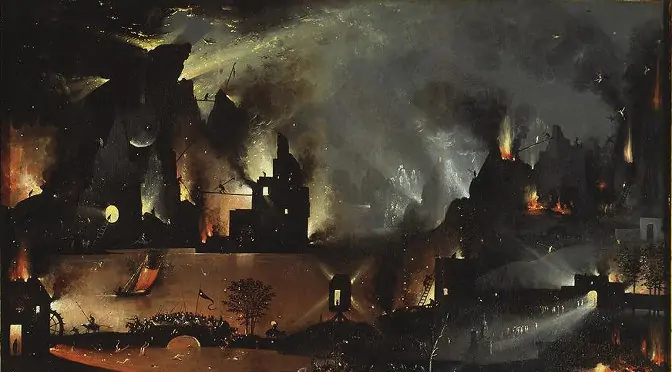
By StMH (Own work), GFDL or CC-BY-SA-3.0-2.5-2.0-1.0, via Wikimedia Commons

One night Novcybio Everstate is burnt to the ground with the test crops planted on its land. Immediately, the Regional Union and various countries appeal to Everstate’s central government to put its house in order, while Novcybio International asks for compensation. When central officers are sent to the site of the arson to investigate, they are denied entry by angry citizens. As they ask for police support, local authorities refuse it, arguing that they will deal with the problem, which does not concern in any way central authorities.

Everstate’s central political authorities should answer to this direct denial of their power by imposing their will, sending the army if need be. However, considering the highly tense situation, they hesitate, afraid of the consequences. Furthermore, Novstate, which provides both some of the police forces of the Continental South-East and many of the Everstatan armed forces, does not favour seeing its men fighting each other.

The new episode of the global financial crisis that starts in October lessens the international political pressure put on Everstate to remedy to its internal disorder. Other countries, as well as the Regional Union, are now focused on other more important matters. For Everstate, the new general break on liquidity that ensues, as the country is still as dependent as ever on international borrowing, means that it must face new difficulties to pay its remaining central civilian and military staff. Local authorities are also impacted, however in various ways according to the situation of each city and region. Everstate does not participate in the international discussions trying to deal with the global financial disorder, except through Novstate, which is present along other powerful private sector’s representatives.

Italian sphere of influence in Turkey according to the agreements of 1917 in Saint-Jean-de-Maurienne by Arthur James Balfour (1848-1930), Public domain, via Wikimedia Commons

When a new conflict starts in the Middle East, Everstate, which used to be an important player in this region, is not even invited to the summits that take place to try bringing back peace. The Renewers then judge that the country is falling apart, has lost a tremendous amount of crucial international influence and is falling prey to parochial problems that not only do not address the initial real challenges and pressures that endanger the lives of all Everstatans, but, on the contrary, aggravate them. The Renewers thus ask for a resignation of Everstate’s government and for the end of the Mamominarch system.

To be continued

2013 – 2018 EVT – Tragic events

Gallery

This gallery contains 9 photos.

The tragic events that strike Everstate are instances of the various conditions presiding to Everstate’s destiny, considering what has been done, or not, globally, regionally and within Everstate. The same set of events will be used to stress test each … Continue reading

2013 – 2018 EVT – Involution (Mamominarch)

Last weeks’ summary: In 2012 EVT, Everstate (the ideal-type corresponding to our very real countries created to foresee the future of governance and of the modern nation-state) knows a rising dissatisfaction of its population. To face the various difficulties and widespread discontent, in a first scenario, Everstate’s governing bodies implement as policies the conclusions of the Mamominarch Commissiona programme of drastic reduction of public expenses over five years through devolution, privatisation and outsourcing. By 2018 EVT, the policies do not lead to a current account surplus as expected nor to a reimbursement of public debt but to a rising current account deficit as well as to the withering away of the nation’s income.

(The reader can click on each picture to see a larger version in a new tab – a navigating map of posts is available to ease reading – research note at the bottom of the post).

The withering away of the nation’s income would imply, under a system other than Mamominarch (minimization of state’s spending as core principle), an acknowledgement of the need for new resources and income. Here, however, considering the core beliefs upheld, this is impossible. Yet, taxes still exist, including the new, temporary ones decided back in 2012 EVT. Those should allow bridging the gap until the budget situation becomes balanced again and a large part of overseas debts is reimbursed. Now, as the overall income of the nation shrinks (added to other linked factors) and as no new resources are looked for, the overall level of resources extracted decreases, despite the 2012 EVT supplementary taxes. This, in turn, does not lead to a balanced budget as hoped, but to a renewed deficit, although smaller. Meanwhile, debts cannot be reimbursed.

Going on trying to balance the budget through the Mamominarch system will only lead to a regressive spiral of further reductions of state’s expenses, which, in turn, will mean less income for the nation, which will imply further slahes in state’s expenditures, etc.

The shrinking of the income of Everstate as a nation also impacts the power of the ruler, i.e. the nation and its governing bodies. This weakens, unsurprisingly, the bargaining position of the ruler regarding the elite and the strength of the central order. Those impacts are in line with the Mamominarch system, which promotes privatization and outsourcing on the one hand, devolution, on the other.

Another factor seriously undermines the power of the nation and of its governing institutions: the dissolution of the legitimate monopoly of violence. First, outsourcing spreads when external military pressures and threats do not relent. Meanwhile, outsourcing  added to an ever weakening central order and power means less control over the way threats are perceived, monitored, labeled and faced, while the entities perceiving, monitoring, labeling and acting on the threats are driven by profit and not by national interests.

Then, local criminality and organised crime are on the rise. In the poorest areas of Everstate, the minimal level of local public funds makes it difficult to hire the police force necessary to face rising difficulties, and impossible for private contractors to take over as benefits would be too low. Nationally, despite Novstate’s central database and communication system, the delocalisation of police force and the use of multiple private contractors makes it extremely complex to follow, analyse and understand flexible criminal organisations used to take advantage of weaknesses of central power, while coordinated action is even more difficult. As a result, spreading pockets of lawlessness develop, while Everstatans start experiencing very different lives according to  where they live.

Finally, the withering away of the nation’s income impacts Everstate’s governance.

True enough, devolution, increased reliance on the Regional Union and management by the private sector were meant to compensate such probable impacts. However, as seen, things did not work this way on the whole territory and governance increasingly becomes fragile, and less efficient.

As further example, the sudden inflow of capital and arrival of highly paid foreign executives at the beginning of the Mamominarch period led to a sharp increase in real estate prices in those areas favoured by foreign investors. As it had not been anticipated, and as, anyway, it favoured real estate owners, notably elite groups, it was considered as positive. Yet, the real estate boom also created a difficult situation for local people, as wages remained frozen considering the otherwise uncertain and even negative global context. In those cities, areas and villages where the real estate boom occurred and where prices still remain very high, demonstrations and protests take place.Yet, they are never of a national scope – as different places are impacted differently – and rarely mentioned beyond local news. Those responsible for local governments do not either report them to central authorities as, anyway, at national level, there is no one in charge of this problem anymore. Each locality deals with the problem solely according to its own idiosyncrasies, and with its own resources, which impairs the implementation of sustainable solutions.

In those areas of the East and South, which have not attracted foreign investment, unemployment rises, poverty and inequality increase and a feeling of injustice deepens and spreads. Yet, these provinces used to be rich as they were those where agriculture had traditionally been done. But now, even rising food prices do not allow smaller exploitations to live properly considering the surging cost of life, notably generated by unmitigated new resources’ conditions. Left to their own device, without any help from local administrations too poor to do anything, people migrate away to richer areas, where they are used as cheaper labour. As the situation is far from full employment, they generate hostile feelings from the indigenous populations who cannot compete. Completely new tensions, declined in nationalistic terms, start appearing, when none existed previously.

Meanwhile, some wealthy Everstatian entrepreneurs start buying land in those areas at a very low price. For example, one of them is contracted by a foreign company, Novcybio, which develops new biotechnologies, to test its products on his land for a high premium.

Everstate’s economy has grown very inefficient for the vast majority of Everstatans. The security provided to Everstatans has not only not been improved but, on the contrary, is degrading.

We are thus back to dynamics similar to those existing in 2012 EVT, before the Mamominarch Commission, but to those must now be added the unintended unfavourable  impacts specific to the Mamominarch system.

This is when tragic events strike.

To be continued

———-

Further research

As we progress in the scenario, it becomes obvious that the initial model could be improved along at least two lines:

  1. As noted initially, if the model was computerised, we should be able to truly follow dynamically, time segment by time segment, the evolution of the situation. Here, because of the absence of such a computerised power as well as for the sake of narration, we have to take a much less detailed approach and to synthesise it by broad themes. This leads us to reflect upon the way we are used to organise and present our thoughts, more according to categories than to dynamic processes, and that could, in itself be an impediment to a proper handling of transition situations, when “everything seem to happen at once.” Research on other ways to present situations, that would nevertheless be appealing and cognitively understandable could be rewarding.
  2. Recalling the difficult problem of levels of analysis, as identified by Waltz (1959), it would be interesting to develop also the model on different layers, i.e. global, regional, central and national, local, according to the various existing layers of governance.

Kenneth Waltz, Man, the state, and war: a theoretical analysis, New-York: Columbia University Press, 1959.