Pattern – Towards Polarization in the Western World?

The Pattern series will look at current pieces of information taken most often in group or cluster. Briefly, it will underline the pattern that could be emerging, what it means, potentially, for the related issues we follow. 

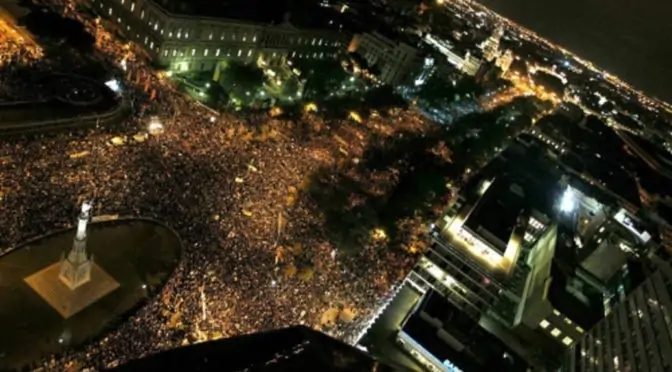
Following the 14 November 2012 strikes, the likely pattern that is emerging is a rising polarization within Western society – or societies – with more demonstrations and protests in the near future, which will probably expand in terms of participation, geographical scope and content of demands. Dismissal – easily interpreted as despise – absence of satisfying answer and feeling of unfairness will most likely enhance tension, opening the door to violence under various forms.

Analysis

As a consequence of the responses given by governments to the financial institutions and sovereign debt crisis, austerity policies, protests have spread throughout the Western world since March 2011. On 14 November 2012 a Europe-wide strike was organised and saw millions of demonstrators taking to the streets with variations according to countries. The demonstration shows a rising coordination across countries and mobilization of citizens. It is however still mainly peaceful despite sporadic violence.

#14N: millions join largest European strike ever, Jerome Roos, Reflections on a Revolution ROAR: Street battles break out and large parts of Europe are paralyzed as millions of workers walk off their jobs in the biggest coordinated EU…

The general demonstration occurred as the Euro zone was not yet considered as being in recession. However, as now recession is official and expected to last, then the causes for the mobilization remain, letting us expect more protests to come.

Euro zone seen sinking into recession as Germany struggles, Robin Emmot,  BRUSSELS, Nov 15 (Reuters): French economy seen stagnating; Germany to grow just 0.2 pct; The euro zone likely slipped in…

If peaceful protests are, however, considered as useless, notably by the conservative and liberal financial establishment, then it is most likely that demands will not be heard, and worse, that peaceful demonstrations will be dismissed. It may be seen as the real response to the demonstration, actually a hardened position. As recession may also increase the fear of diminishing profits, then a softening posture is unlikely. Furthermore, one may also imagine that a continuing recession added to failed efforts by demonstrators to bring about change would be an opportunity to actually increase profits – and power – on the short and medium term by breaking any opposition, thus by changing the second half of the 20th century related balance of power. This would also imply a tendency towards a harsher position.

Big Europe Strikes Have Little Effect, Wall Street Journal: General strikes and sporadic violence against government austerity programs racked Spain, Portugal and Greece, but they appeared unlikely…

2012 EVT – Scenario 2 – Panglossy: Same Old, Same Old

Last weeks’ summary: In 2012 EVT, Everstate (the ideal-type corresponding to our very real countries created to foresee the future of governance and of the modern nation-state) knows a rising dissatisfaction of its population. Everstate is plagued by a deepening budget deficit and an increasing need for liquidity, with a related creeping appropriation of resources while the strength of central public power weakens to the profit of various elite groups. An outdated world-view that promotes misunderstanding, disconnect and thus inadequate actions presides to its destiny. Henceforth, the political authorities are increasingly unable to deliver the security citizens seek. Risks to the legitimacy of the whole system increases. Alarmed by the rising difficulties and widespread discontent, the governing authorities decide to do something. Of the three potential scenarios or stories that follow, we now start the second, “Panglossy: Same Old, Same Old,”* after having seen the end of Mamominarch: Off with the State.”

(The reader can click on each picture to see a larger version in a new tab - navigating map of posts is available to ease reading).

In 2012 EVT, as Everstate’s governing authorities and more specifically national representatives start thinking they should do something to face the various difficulties they meet and notably the rising discontent, a new period of elections opens up. Thus, what matters to the national representatives now is to win the elections for a new term. It is not anymore a fear of losing power because their legitimacy as efficient rulers (being able to deliver what they have been elected for) is questioned. They need now to convince citizens that they are the best to represent the nation and govern it and that they are better than their usual competitors.

As political parties are built around a programme and according to specific lines of thoughts, the rationale of the electoral competition asks them to follow the core of those programmes to demarcate themselves from their adversaries. When each party was formed, this formation led to the construction of a unique program upon which various national representatives and parliamentary groupings agreed. This program was also built to allow for the mobilization of electors needed to see the representatives elected. However, as with the way ideological and normative belief systems and socio-political models are constructed, this mobilisation was done in the past. The problems it sought to answer are past challenges. Furthermore, it could only be built according to the socio-political model and normative framework of that time. Over time, with each election, each of the two programmes has evolved but could do so only within relatively tight boundaries. Hence, the two main parties about to dispute the elections in Everstate are both abiding by the modernizing norm, constructed around materialistic improvement, each representing, as in most of the liberal world, two ends of the same spectrum, one of social-democrat inspiration, the other with a more conservative stance.

Thus, now, if the real severe problems faced by the nation must be considered, solutions can nevertheless only be envisioned within the framework of those existing programmes, as well as within the existing socio-political model and norms. For the two major classical parties, trying to change their framework and their programme in a very substantial way would mean risking changing the existing mobilisation forces and upsetting existing parliamentary groupings, thus risking losing the elections, which, ultimately would imply not being in power.

Battles are thus pitched on relatively minor points, when seen from the point of view of the huge challenges the nation must face. From the point of view of many people who are not only electors, but also those very people who seek security, experience pressures in their everyday life and are increasingly dissatisfied, such battles contribute to further de-legitimise whoever will become the nation’s representatives, thus the government, and indeed the existing parties’ system.

Meanwhile, a combination of apparent renewed optimism, notably expressed through better statistics, for example a slightly rising consumers’ spending, especially abroad, through bullish financial markets  and stock exchanges worldwide, a slow down of protests both within Everstate and worldwide, with a fear that those protests could start again, tends to comfort the potential nation’s representatives in the validity of their old aims and programmes and in their wish to come back to the situation ante, i.e. before everything started to unravel. Chief among those aims, Everstate must obtain economic growth again. The crisis is severe, indeed, but it is certainly temporary as those optimistic signs show. Unfavourable, negative trends are still at work, and those must be faced and stopped. But the goal is clear and the framework for doing so is pristine, and it may only work, as it has always worked since the parties were created.

The rise of the BRICS (Brazil, Russia, India, China, South Africa), prompted by the current modernising and materialistic paradigm, only fuels this vision. Be they upheld as a threat against which one must struggle or as new partners with whom one must cooperate, their recent success is one more evidence of the correctness of the existing system. As a result, the awareness of the new pressures that had started to emerge recedes and those are considered as not really important or, if they are, their timing is uncertain, thus, if ever such threats materialise, it will be later.**

Hence, nothing fundamentally changes. On the contrary, habits and the existing system, once the new national representatives are elected and the new government starts ruling are even more entrenched, almost ossified. 

Yet, something unexpected, dismissed by observers, is also happening during the months leading to the election. To be continued

———–

* The name for this scenario, Panglossy, comes from the famous character Pangloss in Voltaire‘s work Candide ou l’Optimisme (Candid : or, All for the Best – 1759). Candide is an attack on Leibniz’s optimism, seen as absurd in the light of the many ills of the world. The absurdity of optimism is notably conveyed through the explanations for the series of  catastrophes met that Pangloss, Candide’s preceptor, gives and that always emphasise that “all is for the best.”

** Note that the absence of interest existing on timing and the sparse research on this factor may only ease the ability to deny reality.

Images

A frontispiece of Voltaire’s Candide (Paris : Sirène, 1759). It reads, “Candide, or the Optimism. Translated from the German by Dr. Ralph.” [Public domain], via Wikimedia Commons.

This file comes from the website of the President of the Russian Federation. Kremlin.ru [CC-BY-3.0 (http://creativecommons.org/licenses/by/3.0)], via Wikimedia Commons.

2012 EVT: Seeking Security (The Chronicles of Everstate)

Last week’s summaryIn 2012 EVT, in Everstate (the ideal-type corresponding to our very real countries created to foresee the future of the modern nation-state), the population’s discontent increases – and is bound to continue to do so – as a result of various pressures and threats, most of them inevitable, imperfectly identified, and not understood. Indeed, Everstatans feel both directly and indirectly the impact of those pressures, which affect their sense of security and thus generate discontent.

(The reader can click on each picture to see a larger version in a new tab).

Everstatans seek security

Everstatans continue to seek a security that is appearing as increasingly distant and elusive.

They turn to their political authorities, expecting them to deliver this security. Indeed, Everstatans believe that their government, their state (which assists the ruler in its tasks) and their national representatives, being their legitimate political authorities, should ensure their security. This fundamental belief is inscribed in their collective history, not only as a country, but also as part of the human species (Moore, 1978). Furthermore, Everstate is part of the normative order called liberal democracies. Thus, as Everstatans have elected their representatives and their government, they are even surer of their right to be well governed, i.e. to see their security ensured.

However, most of the time, they have forgotten that, as citizens on the one hand and as part of the collective body of the nation on the other, they are also a part of the political authorities. As such, they not only have a role to play but also a duty to assume it. They cannot just sit there and relinquish their power and responsibilities, all the more so that their security is at stake. This forgetfulness is not a specific trait of Everstatans but widely shared with most of their fellow citizens in other representative liberal democracies.

Initially, Everstatans exerted their power in a rather negative and passive way, witness the growing abstention during elections that had been going on for decades and other worrying weak signals of alienation. Now, their grumbling grows louder and is a first still inchoate way to act to make sure their government, their state and their national representatives consider their demands. Furthermore, other actions, more visible, such as strikes and demonstrations – sometimes with some violence - also take place with an increasing frequency while creeping unrest and rising lawlessness settle in some very specific areas.

As all those actions originate from different groups of citizens and take various forms with different purposes, for most observers, including Everstatans, they appear as unrelated, dispersed and thus of no consequence. Worse still for those witnesses, when a protest movement seems to be a bit more constructed – e.g. the Occupy Everstate movement, part of the global Occupy/Indignados movement – it starts with a specific demand, linked to the impacts having generated dissatisfaction, then, when satisfaction is not obtained, the scope of the discontent in terms of content increases, usually giving rise to another supplementary revendication. This leads most to completely discredit the various movements of protest, all the more so that the new very real pressures Everstate has to face are still very imperfectly perceived and measured. Indeed, seen from the surface, the protests are sporadic, actively involve relatively few people, flare up and then recede. However, imperceptibly, overtime, the overall level of tension increases, the number of people likely to be actively involved in protests rises, while the scope of discontent widens.

Wrong answers

As the responses of Everstate’s government, state, and Parliament generate dissatisfaction, it seems that they are increasingly unable to answer the population’s demands, which stem from the real situation, the citizens need for security and the beliefs they hold.

Things are however more complex than a sudden incompetency or, more absurd, malevolence, as some extremist Everstatan conspiracy theorists try to promote.

Everstatan political authorities, indeed, have  to provide a governance that has become progressively more complex and thus difficult Governance implies more tasks, many of them novel. Security must be delivered to citizens  in overall conditions that have changed. The various pressures for survival and military threats as well as their intensity demand attention, resources, policy and successful responses. Meanwhile, the evolution of resources available, as well as their rising complexity, for example all those related to the virtual and mobile world, again ask for fully novel policies and practice.

Logically those new tasks require new staff as well as new resources and income, past ones having become ill-suited, insufficient or even exhausted.

In this framework and because of it, three related phenomena are at work that drive the political authorities’ current incapacity to deliver security and thus  the rising population’s dissatisfaction, while also directly adding to the discontent: a deepening budget deficit and an increasing need for liquidity, a creeping new appropriation of public resources and a weakening of the strength of central public power to the profit of various elite groups, and finally the use of an out-dated normative model leading to misunderstanding and disconnect as long as the demand for new understanding is not satisfied.

To be continued

Reference

Moore, B., Injustice: Social bases of Obedience and Revolt, (London: Macmillan, 1978)

Revisiting timeliness for Strategic Foresight and Warning

To exist, foresight products as well as warnings must be delivered to those who must act upon them, the customers, clients or users. Furthermore, they must be provided in a timely fashion. This criterion of timeliness is extremely important. It means that customers or users will have enough time to decide and then implement any necessary course of action as warranted by foresight.

Timeliness: enabling the coordination of response

Timely reflections (Image by Stanley Howe – CC-BY-SA-2.0, via Wikimedia Commons)

Most often, the challenge of timeliness is thus understood as stemming from the need to conciliate on the one hand the dynamics which are specific to the issue, object of anticipation, and on the other the related decision and coordination of the response.

Let us take the example of Peak Oil, i.e. the date when “world oil production will reach a maximum – a peak – after which production will decline” (Hirsch, 2005, 11) which implies the end of a widespread availability of cheap (conventional crude) oil. The phenomenon is now well documented and relatively widely recognized, from scientists’ reports, associations, institutions and books (see, for example, the creation of the Association for the Study of Peak Oil & Gas in 2000 , Robert Hirsch report (2005), the Institut Français du Pétrole (IFP), Thomas Homer Dixon, Michael Klare or Jeff Rubin), to web resources such as The Oil Drum or Energy Bulletin to finally the International Energy Agency (IEA – it recognised the peaking of Peak Oil in 2010, e.g. Staniford, 2010), despite still some resistance by a shrinking number of actors.

By azrainman http://flickr.com/photos/azrainman/991225765/ – CC-BY-2.0, via Wikimedia Commons

Notwithstanding other impacts, Hirsch estimates that 20 years of a “mitigation crash program before peaking” would have allowed avoiding “a world liquid fuels shortfall” (Hirsch, 2005). Assuming that oil peaked in 2006, as evaluated by the IEA, if we had wanted to have an energy mix of replacement for the now gone cheap oil, then we should have decided implementing and then coordinating a response… back in 1986. Thus SF&W on this issue should have been delivered some time before 1986.

Obviously, this did not happen, even if one starts finding rare articles regarding Peak Oil earlier (e.g. the 1974 miscalculated warning for a global Peak Oil happening in 1995 by M. King Hubbert (Wikipedia ‘Predicting the timing of Peak Oil’) and much later Colin J. Campbell and Jean H. Laherrere, “The end of cheap oil,” Scientific American, March 1998). Why?

Timeliness, credibility and biases

Jack Davis, writing on strategic warning in the case of US national security, hints at the importance of another criterion linked to timeliness, credibility:

“Analysts must issue a strategic warning far enough in advance of the feared event for US officials to have an opportunity to take protective action, yet with the credibility to motivate them to do so. No mean feat. Waiting for evidence the enemy is at the gate usually fails the timeliness test; prediction of potential crises without hard evidence can fail the credibility test. When analysts are too cautious in estimative judgments on threats, they brook blame for failure to warn. When too aggressive in issuing warnings, they brook criticism for “crying wolf.”

For Davis, credibility is the provision of “hard evidence” to back up foresight. Of course, as we deal with the future, hard evidence will consist in understanding of processes and their dynamics (the model used, preferably an explicit model) added to facts indicating that events are more or less likely to unfold according to this understanding.

Credibility is, however, also something more than hard evidence. To obtain credibility, people must believe you. Hence, biases of the customers, clients or users must be overcome. Thus, whatever the validity of the hard evidence in the eyes of the analyst, it must also be seen as such by others. The various biases that can be an obstacle to this credibility have started being largely documented (e.g. Heuer). Actually, explaining the model used and providing indications, or describing plausible scenarios are ways to overcome some of the biases, notably out-dated cognitive models. Yet, relying only on this scientific logic is insufficient, as shown by Craig Anderson, Mark Lepper, and Lee Ross in their paper “Perseverance of Social Theories: The Role of Explanation in the Persistence of Discredited Information.” Thus, other ways to minimize biases must be imagined and included, that will most probably involve time. The possibility to deliver the SF&W product will be accordingly delayed.

Credibility and more broadly overcoming biases are so important that I would go further than Davis and incorporate them within the very idea of timeliness. This would be much closer to the definition of timely, according to which something is “done or occurring at a favourable or useful time; opportune” (Google dictionary result for timely). Indeed there cannot be timely SF&W if those who must act cannot hear it.

If the SF&W product is delivered at the wrong time, then it will be neither heard nor considered, decisions will not be taken nor actions implemented.

More difficult, biases also affect the very capability of analysts to think the world and thus to even start analysing issues. We are there faced with cases of partial or full collective blindness, when timeliness cannot be achieved because SF&W analysis cannot even start in the specific sectors of society where this analysis is meant to be done.

This is most probably what happened for our example of Peak Oil. If a model existed, created by M. King Hubbert, the initial miscalculation led to some loss of credibility as those denying peak oil underlined and still emphasize, even though King Hubbert model was not wrong. Analysts in SF&W in the early 1980s were more preoccupied with the Cold War than concerned by anything else. Afterwards, the system that had won against the Communist world could not even be thought not being perfect. Such highly disturbing threats that could question the prevalent worldview could not be envisioned. Had they been, they would most probably have been discarded first by policy makers then by political leaders. Furthermore, a host of actors had interest in a permanence of the ideological setting, which would have made the possibility to see a very early foresight work on peak oil develop very remote indeed (I am emphasizing here unconscious reactions and “deafness,” not hidden maneuvers).

Timeliness as the intersection of three dynamics

Thus, to summarize timeliness is best seen as the intersection of three dynamics:

  • The dynamics and time of the issue or problem at hand, knowing that, especially when they are about nature, those dynamics will tend to prevail (Elias, 1992)
  • The dynamics of the coordination of the response (including decision)
  • The dynamics of cognition (or evolution of beliefs and awareness) – at collective and individual level – of the actors involved.

To understand each dynamic is, in itself, a challenge. Even more difficult, each dynamic acts upon the others, making it impossible to truly hope to achieve timeliness if the impact of one dynamic on the others is ignored.

For example, if we continue with our initial case of Peak Oil, having been unable to even think the possibility of Peak oil in the early 1980s has dramatically changed the current possible dynamics of the response, while both the cognitive delay and the absence of previous decisions and actions have orientated the dynamics of the issue towards some paths, while others are definitely closed. Any SF&W delivered on this issue now is quite different from what would have been delivered 20 years ago, assuming it could have been heard.

To acknowledge the difficulty of finding the timely moment, and the impossibility to ever practice an ideal SF&W in an imagined world where everyone – at individual and collective level – would have perfect cognition is not to negate SF&W. Answering this challenge with a “what is the point to do it now as we did not do it when things were easy/easier” is childish. On the contrary, fully acknowledging hurdles is to have a more mature attitude regarding who we are as human beings, accepting our shortcomings but also trusting in our creativity and capacity to work to overcome the most difficult challenges. It is to open the door to the possibility to develop strategies and related tools to improve the timeliness of SF&W, thus making it more actionable and efficient:

  • Creating evolving products that will be adapted to the moment of delivery;
  • Using the appearance of groups, communities, even single scholarly or other work on new dangers, threats and opportunities as potential weak signals that are still unthinkable by the majority;
  • Developing and furthering our understanding of the dynamics of cognition and finding ways to act on them or, to the least, to accompany them;
  • Participating fully in the current effort, which has just started within societies, at re-designing decision systems and response capabilities.

———————————

References

Anderson, Craig A., Mark R. Lepper, and Lee Ross, “Perseverance of Social Theories: The Role of Explanation in the Persistence of Discredited Information,” Journal of Personality and Social Psychology 1980, Vol. 39, No.6, 1037-1049.

Campbell, Colin J. and Jean H. Laherrere, “The end of cheap oil,” 
Scientific American, March 1998.

Davis, Jack, “Improving CIA Analytic Performance: Strategic Warning,” The Sherman Kent Center for Intelligence Analysis Occasional Papers: Volume 1, Number 1, accessed September 12, 2011.

Dixon, Thomas Homer, The Upside of Down: Catastrophe, Creativity and the Renewal of civilization, (Knopf, 2006).

Elias, Norbert,  Time: An Essay, (Oxford: Blackwell, 1992)

Hirsch, Robert L., SAIC, Project Leader, Roger Bezdek, MISI, Robert Wendling, MISI Peaking of World Oil Production: Impacts, Mitigation & Risk Management, For the U.S. DOE, February 2005.

International Energy Agency (IEA), World Energy Outlook 2010.

Klare, Michael, Blood and Oil: The Dangers and Consequences of America’s Growing Dependency on Imported Petroleum, (New York: Metropolitan Books, 2004; paperback, Owl Books, 2005).

Klare, Michael, Rising Powers, Shrinking Planet: The New Geopolitics of Energy (Henry Holt & Company, Incorporated, 2008).

Rubin, Jeff, Why Your World is About to Get a Whole Lot Smaller: Oil and the End of Globalization, Random House, 2009.

Staniford, Stuart, “IEA acknowledges peak oil,” Published Nov 10 2010, Energy Bulletin.

“Delivery” of Strategic Foresight and Warning “products:” learning from the social and mobile web?

As Cynthia Grabo underlines, a warning does not exist if it is not delivered. Similarly, a foresight product – or risk assessment or horizon scan – has to be delivered. Furthermore, if foresight and warning are to be actionable, then clients or customers – those to whom the product has been delivered – must pay heed to the foresight, or warning. What they decide to do with those is another story, but from the point of view of SF&W, they must receive them, know they have received them and as much as possible consider them.

by Philip Devere, FAL, via Wikimedia Commons

Strategic foresight and futures’ efforts, as well as related literature, with a few exceptions, have rarely focused explicitly on this specific part of the overall process. Yet, it is crucial. As a first step, it has much to learn from the warning part of the activity. Then, both strategic foresight and warning may also have much to learn from the mobile and social networking approach that is being constantly imagined and re-imagined.

Learning from warning

In a nutshell, the – ideal – approach that strategic actionable foresight must learn from warning underlines that:

  • Clients or customers must be identified – mapping is a must.
  • Warning officers – and thus strategic foresight practitioners too – must learn to know their customers and develop overtime a trusting relationship with them
  • Products can thence be adapted to customers
  • Products must be delivered to customers and related necessary channels of communication created if need be
  • Feedback on delivery and products must be asked customers, hoping the latter will have time to provide them.

If those steps are followed then we have improved the likelihood to see our customers paying heed to foresight and warning products. Many challenges, however, are lurking behind those apparently simple steps, potentially hindering the best completion of each of them. First and foremost, the various biases, as summarized by Heuer, that alter the understanding of any human being, will be at work. They will affect not only customer but also analyst and officer in their relationship to customers, as astutely pointed out by Woocher.

Learning from the social and mobile web: from Taylorism and consumerism to the 21st century

Without entering into the specifics of each bias and each challenge, which is more than a blog post can do, I would like here to suggest that the social and mobile web could help us with this specific phase of the SF&W process. It could not only by give us new capabilities but also, and primarily, a new philosophy.

Moving from customers to users

Usually, chains of command and hierarchical structures define who gets SF&W products. They have been established over time, exist and are necessary as such. Yet, as far as those traditional existing “customers” or “clients” are concerned, most usually policy-makers and decision-makers, could it be worthwhile to change our mind-set, not seeing them anymore as “customers,” but, instead, as is done by the mobile and social web, considering them as users? Customers are those to whom one sells products or services, if we pursue the analogy (with all the potential biases this imply, as for example studied by Nolan, MacEachin, and Tockman).

Meteorologist at work at the Storm Prediction Centre de Norman, Oklahoma Source: NOAA

Users refer to a different universe. It imply that we provide them with tools (concrete or immaterial), instruments that are first and foremost useful and of value to them; devices that are needed to construct, to act, that will be helpful in the accomplishment of their mission. The emphasis moves from something that can be useless, that can been thrown away or disregarded and that is separated from the person who must buy it, to a long-term relationship, to the consideration of the other and its needs first – or rather the needs of its mission. This would be somehow adopting the first core principle of Google’s philosophy.

If we adopt the user’s approach, then we can start our process of identification again, with a fresh mind:

  • Are we sure that all the necessary, actual and potential users have been identified?
  • Would other people benefit from using SF&W?
  • Would it be a useful tool for them? Would it be necessary that they used it?

Those questions are more difficult than it appears for polities as they also touch upon democracy on the one hand, and power on the other.

First, in a representative democracy, policy-makers are those who are elected, and decision to act (or not act) should remain in their hands. Thus, care will be taken when or if new users are outside the nexus of elected representatives to see the democratic process respected.

Second, SF&W is (or should be) an essential tool of power, of might (the German Macht – verb machen = do) in its meaning of doing something. Thus, identifying new users may potentially lead to power struggles and care should be taken in advance to mitigate such drawback.

Moving from product and delivery to tools and reception

Currently, once all the policy-makers and decision-makers are known, then the most advanced practitioners design specific format and delivery – seen as a unified process – for the product, according to clients. The form and the delivery must be adapted to customers and will achieve the aim to get their attention and raise their awareness.

By National Weather Service Aviation Weather Center (http://aviationweather.gov/products/swm/), Public domain, via Wikimedia Commons

If we move to users, then product becomes tool, the emphasis on delivery can switch to reception, and then one should also think about the use of the tool.  An overall strategy, centered on the actionable use of SF&W can thus be imagined, designed and implemented.  One will have to ask questions such as

  • In which circumstances and how would the users use the tool?
  • Which form should this tool have to best be used by them?
  • What are the best channels that will give the best possible reception by the user? Considering the difficulty of changing mind-sets, which is one hurdle SF&W must always overcome, this question is particularly important as it will also lead us to try identifying how the users think, the dynamics behind cognition, including most opportune moments, what and who has influence on their thinking.

Once we switch to the users’ approach, then the capabilities of the social and mobile web can be fully integrated and adapted to SF&W. We shall examine specific ideas in future posts.

——————

Grabo, Cynthia M., and Jan Goldman. Anticipating Surprise: Analysis for Strategic Warning. [Washington, D.C.?]: Center for Strategic Intelligence Research, Joint Military Intelligence College, 2002.

Heuer, Richards J. Jr., Psychology of Intelligence Analysis, Center for the Study of Intelligence, Central Intelligence Agency, 1999.

Nolan, Janne E., and MacEachin, Douglas, with Kristine Tockman, Discourse, Dissent and Strategic Surprise Formulating U.S. Security Policy in an Age of Uncertainty. Washington, D.C.: Georgetown University, Institute for the Study of Diplomacy, 2007.

Woocher, Lawrence, “The Effects of Cognitive Biases on Early Warning,” Presented at the International Studies Association Annual Convention (2008).