2018 – 2023 EVT – From Grievances to Political Mobilisation (Mamominarch)

Last weeks’ summary: In 2012 EVT, Everstate (the ideal-type corresponding to our very real countries created to foresee the future of governance and of the modern nation-state) knows a rising dissatisfaction of its population. To face the various difficulties and widespread discontent, in a first scenario, Everstate’s governing bodies implement the Mamominarch programme of drastic reduction of state spending over five years through devolution, privatisation and outsourcing. By 2018 EVT, the result is involution, with a fragilised governance including and implying the rise of lawlessness domestically, an abandoned mastery over international security, an inefficient economy and, as consequence, a rising insecurity for most Everstatans. The first set of tragic events - a tornadoes outbreak followed by a heat wave – that hits the West of Everstate soon becomes a complex catastrophe with dramatic direct and indirect impacts.

(The reader can click on each picture to see a larger version in a new tab – a navigating map of posts is available to ease reading).

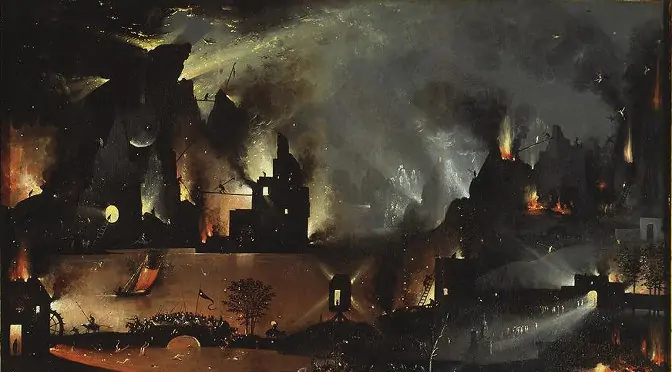
Faced with destruction and a difficult and very slow reconstruction, Westerners are definitely dissatisfied with the way their political authorities, entrusted with the mission to ensure their security, have dealt with the complex catastrophe that befell them. Many are forced to leave as their survival is threatened and start moving towards other areas. However, they nevertheless expect recognition of their hardship, help and solidarity when they arrive somewhere else.

Yet, nothing is organised nationally. The way they are greeted varies greatly according to areas and even towns. In some cities, local authorities engineer emergency support for newcomers in the name of national solidarity, while everything is done to help them find temporary shelter and work. In others, only family network, when they exist, are active, and the refugees are not only ignored, but also rejected as they are seen as swelling the mass of the poor, homeless and unemployed, as potential criminals, as people lowering wages when they end up taking any job to survive. In those areas, as the refugees remind inhabitants of a selfishness they do not want to confront and of problems they want to deny, rejection hardens quickly.

All Everstatans, finally, feel unjustly treated, one way or another, which only feeds grievances. Those multiply as central political authorities do not acknowledge problems, give no recognition, and do nothing in a timely way. The victims are not supported in those areas where they are best welcomed and those who help them are left to their own device and funding, while the central administrative machine and policies continue as if nothing had happened, sometimes thus enhancing difficulties. Elsewhere fear is not assuaged, its roots are not dealt with. Notably, no one wants to face the fact that the refugees have become a disturbing symbol of a dysfunctional and outdated model of socio-political organisation, when so much hope had been invested in the Mamominarch system.

Over the summer, oil prices surge, with some spikes even reaching 200$ a barrel, as a result of renewed international tensions in the Middle East. This trend intensifies the overall situation in Everstate, as for most Everstatans, save the richest and best connected, life becomes increasingly difficult. Indeed, whatever the efforts the people have previously made, the result of their actions to improve or to the least stabilise their life is reduced to naught by the severe disturbance implied by the energy price. As, furthermore, the food produced in Everstate has become suspect – and sometimes rightly so – because of the industrial disasters, many Everstatans feel that they are left with only two bad choices: either starve because they cannot afford imported food, or kill themselves with polluted food.

The legitimacy of the Mamominarch system is now overtly questioned, and all remember that the governing bodies that decided to convene the Mamominarch commission were already facing similar problems, which only contributes to further de-legitimize the system.

The rising tension spreads throughout the whole country. If all have grievances, those accumulated complaints tend to coalesce and join along different fault lines according to areas and groups, because there is not anymore one national situation but many, notably as a result of the devolution  (spatial variations) and of the privatizations (end of the concept and practice of public good). With time, events and a large variety of responses, the conditions have grown to be very diverse.

External observers are surprised when, building on the tension existing in 2012 EVT, then on those that simmered over the past five years of Mamominarch system, and triggered by the recent events, a Movement for the Independence of the Trueland, a region covering the South-East of Everstate (notably the mouth of the river and the seaside), is created and rapidly takes off. The usual inflow of money that used to bring wealth, and, during the last years, release, to the country with tourism is abruptly halted by the complex catastrophe, as tourists fear coming to Everstate. The inhabitants of the seaside area being relatively richer were thought as much calmer and less likely to mobilise politically. But this is without considering the sudden relative deprivation they feel, which is, furthermore, from their point of view, none of their making.  Other small areas, sometimes only cities, follow suit and also start voicing their desire for local independence and direct membership to the Regional Union.

Yet, not all citizens of those areas share the same views, and those who are dissatisfied with the two main political parties, spearheaded by Occupy Everstate, respond by creating a Movement for the Renewal of Everstate, which is soon joined by large parts of the Westerners, by the refugees and many in those towns that put solidarity first. The CEO of Evernet, as reported by international media, decides to join the movement she sees as prefiguring the future. She offers the technical support of Evernet, providing even funding and sometimes directly hardware to the Renewers, as they are soon called, when those cannot afford anymore access to social networks considering the degraded overall situation.

Meanwhile, Novstate and its friends companies make sure they remain officially neutral, offering their services to all, while they continue promoting the system that made their fortune.

Many of those joining the new Movements did not belong, previously, to any political party. They had even often abstained during previous elections. Yet, the two main parties, the conservative and the social-democrat, with still their headquarters in the capital, start losing sympathisers. The classical elite groups remain faithful to the two traditional parties, which have created the Mamominarch system, and start worrying about the evolution of the situation. First, the Western quagmire has marred the international ideological standing of the Mamominarch system, which seriously limits the opportunities offered to the elite.

Then, those new Movements imply a loss of power for the two parties that constitute the usual political framework of the elite, indeed the way its members think and live. The elite groups initially try to dismiss the new Movements because they do not enter the familiar right/left, conservative/social-democrat way to think and thus, certainly, do not correspond to anything serious… yet the political mobilisation is there, as well as the grievances and the tension and altogether they completely deny everything the elite has ever believed in and stood for. The new Movements have not even tried to include them.

The Renewers then pick up on a report according to which a terrorist group has infiltrated a Novcybio laboratory in its home country a few weeks ago, stolen some deadly pathogens and manipulated others, mixing them with some of the genes experimented. Considering the existence of Novcybio Everstate, the news goes viral through social networks, among Renewers initially.

To be continued

2012 EVT: Rising Discontent (The Chronicles of Everstate)

Last weeks’ summaryEverstate (an ideal-type for our very real countries created to foresee the future of the modern nation-state) is part of the international liberal order and ruled under a democratic parliamentary regime. Lately, its governance started being less efficient and as a result began to fail to ensure the security of Everstate’s citizens. Meanwhile, its economy showed sign of losing efficacy and its powerful elite groups fought hard to keep their status although they do not believe to be really at risk. The various degradations and tensions have started being felt and registered by the population. However, most Everstatan actors considered those as temporary crises and difficulties that will be shortly solved. At worst, some envisioned a serious crisis that would last a few years, maybe a decade of slow growth before everything went back to normal. Are they right? What does the future hold for Everstate?

(The reader will find detailed explanations on the methodology applied to this post at the bottom of the text and can click on each picture to see a larger version in a new tab). 

Dissatisfaction and tension of the population

Confronted with various mild but growing inefficiencies in terms of governance and economy, Everstatans are increasingly dissatisfied. They perceive the overall security provided by their political authorities as having started to decrease. At the beginning, it was imperceptible. Now, their discontent increases and cannot be ignored anymore. Indeed, more and more people feel relatively deprived as they contrast what they remember about their past satisfaction, what they had sought to achieve and what they now manage to obtain, whatever their efforts.

First, obvious new external military threats have arisen from foreign groups trying to implement their own state power. Those threats are widely labelled and known as “terrorism” or sometimes “radicalization” and have been partly solved through various efforts, notably those made in the areas of domestic security and law enforcement. Other threats have emerged from states that are considered as unfriendly, indeed at times dubbed “rogue states.” Both have started introducing an element of permanent and pernicious fear and unease in the population.

Then, the satisfaction of the population is affected by other factors that are not yet perceived and even less considered, integrated and successfully dealt with by Everstate’s political authorities.

The evolution of society has, over time, affected the ecological milieu, which has given rise to new types of pressures. In Everstate and in international settings, the reality of those pressures is still debated, which often leads to ignore or minimize their importance. Among those controversies, we find the end of cheap energy, notably oil-based energy, the safety of nuclear energy, food and water availability, climate change, the increase of various types of pollution, and the return of the fear of deadly pandemics. Furthermore, because those pressures are new or have not been felt for centuries, the existing normative models do not consider them. Those models, indeed, focus on other matters, those issues that were crucial when the norms were constructed. Considering the importance of normative models and related thinking, the lack of possible concern integrated within the normative model also contributes to minimise the perception of and interest in those new pressures.

Meanwhile, natural uncontrollable catastrophes such as earthquakes or volcano eruptions, linked to the fate of geography, are still hitting societies blindly. Everstate fears no volcano on its territory, but some areas, by the seashore notably, are prone to earthquakes, although no severe one has occurred for more than two centuries. Typhoons and hurricanes, floods and droughts are still devastating worldwide, but Everstate’s climate makes such happenstance quite impossible. And yet… an increase in frequency and intensity of extreme weather events started being registered a few years ago (e.g. Munich-Re, 2010). Although the scientific understanding of many of those phenomena is still imperfect, a similar trend was registered in many countries of the world. Increasingly, it was identified as related to those changing conditions brought about by human activity.

Furthermore, previous evolutions have affected natural resources. Those that are finite have now been used by the population and thus are obviously not available anymore. Those that are considered as renewable have also sometimes been altered in a way that makes them unavailable for a specific location. For example, if water is fundamentally a renewable resource, the depletion of groundwater in some areas, or pollution, which can only be removed over centuries, in others transform water for specific areas and lapse of time into a finite resource. Such shortages directly impact the population, as people cannot benefit from those resources anymore, be it in terms of direct use or because whole sectors of activity disappear leading to unemployment and general impoverishment. Furthermore, by bearing upon the overall ecological setting, they contribute to create new kinds of pressure for survival. Meanwhile, other potential resources are emerging but are not yet fully integrated into ways of life. Thus, they cannot fully take the place of the past, used resources, when replacement is possible. They cannot either help face the whole range of new pressures for survival. So far, in Everstate, no complete shortage in response to a need had to be faced. On the contrary, in a still recent past as when coal mines were closed, whole sectors of activity have been swept away.

At the same time, evolution has generated new capabilities that are progressively used against society in a deadly and damaging way. Thus, new threats appear. Everstate and its allies have so far labelled those threats as unconventional, which definitely underlines their novelty, even in terms of thoughts. A few of them – but by all means not all as they permanently evolve –  have been identified and range from cyber-security (linked to the digital and communication technology and their use) to the proliferation of weapons of mass destruction.

As long as Everstate has not designed the way to deal (through governance) with those new multiple pressures, the degree with which those pressures impacts society progressively increases, while the level of satisfaction of the population decreases. Now, this way cannot even start being imagined because those stresses are not fully registered and thus even less understood. Indeed, the Everstatan system, as the system of other countries, was built to deal with other – past – pressures.

Thus, dissatisfaction is bound to increase for some time in Everstate. This discontent itself, feeds progressively into a domestic escalation spiral. In turn, it increases incrementally the degree of pressure that is exerted on Everstate as a whole.

Meanwhile, Everstatans continue to seek a security that is appearing as increasingly distant and elusive…. to be continued.

How to? Application of the methodology used to construct the narrative.

The variable that will serve to start the narrative is “pop level of satisfaction (sec) s3,” i.e. level of satisfaction of the population regarding security for the third phase or step of our dynamic model. To help the reader understand the methodology, the words corresponding to an influencing or influenced variable or node for the main narrative will be in bold in this post.

When needed, to obtain more information on those nodes, we shall display the corresponding ego network that will hep nourishing and constructing the narrative.

In terms of outline, we start with the variables causing what we try to narrate (the discontent of the population), looking first at those linked to s2 (the previous step, temporally), then moving to s3. Once all the causing variables have been seen, then one progresses to the impact variables, which will allow us moving the story forward, with the exception of groups of variables, both influencing and influenced, for which the story is clearer if told as a group or system, e.g. the first paragraph. The task of detecting those groups of variables is eased by the use of network visualisation tools as those groups are literally shown by the lay-out (here Force Atlas).

———–

References

Munich Re, ”Extreme Weather Events – Signs of climate change?” 5 August 2010:

“These facts show that global warming is playing a significant role in the rising number of extreme events. Analyses performed by Munich Re’s natural catastrophe database, the most comprehensive in the world, substantiate this increase: the number of extreme weather events like windstorm and floods has tripled since 1980, and the trend is expected to persist.” [my emphasis]