

The aim of the Water Sigils is to be a daily scan focusing on water security. We are currently investigating new AI ways to deliver an even better Water Sigils. The original complimentary version ran from May 2012 to April 2023. The Sigils are a series of scans exploring the horizon for weak signals related to various …
Tag Archives: water security
Turkey: An Energy and Environmental Power

On 1 December 2014, President of the Republic of Turkey Recep Tayyit Erdogan and President of the Federation of Russia Vladimir Putin agreed on the implementation of a new gas pipeline, linking the Russian Federation to Turkey through the Black Sea ( “Gazprom to build new 63 bcm Black Sea pipeline to Turkey instead of South Stream”, Russia Today, December 1, 2014). This new project is called “Turkish stream” and replaces the late “South Stream”, which was meant to connect Russia to Europe, by crossing southern European countries. The decision of Bulgaria to withdraw from the project, in the context of the tensions regarding Ukraine between the U.S. and the EU, on the one hand, Russia, on the other, led …
Continue reading “Turkey: An Energy and Environmental Power”
Oil Flood (2) – Oil and Politics in a (Real) Multipolar World

The world oil flood is quickly rising. As we have seen in “Oil Flood (1): The Kingdom is Back”, the decisions taken by OPEC members and Russia not to curb oil production, while Saudi Arabia is forcing prices down, are much more about power politics and strategies than about economics and the “invisible hand” of the logic of “supply and demand”. We shall now focus on what the evolution of the current oil market reveals about current and future geopolitics. Since the end of November, especially since the 27 November OPEC meeting, prices have kept falling down, while the main producers, chiefly among them Saudi Arabia, Russia, Iran, and the private U.S. companies, have all decided, for reasons of their own, to maintain …
Continue reading “Oil Flood (2) – Oil and Politics in a (Real) Multipolar World”
Egypt and Climate Security

Since 2008, when massive food riots took place, followed by the “Arab spring revolution” in 2011, Egypt has become a land of political, religious and social conflicts (Krista Mahr, “Bread is life: food and protest in Egypt“, Time Magazine, January 31, 2011; Georges Corm, Le Proche-Orient éclaté, 2012), some of them between armed militant and religious factions on the one hand, the police, the military and the secret services, on the other. Meanwhile the civil society strongly emerges. Beyond spectacular events, the causes of these domestic political and religious conflicts are rooted, among other factors, into international and climate change dynamics. In effect, Egypt’s society and politics are deeply affected by the entanglement of economic, political, environmental and climate change …
Continue reading “Egypt and Climate Security”
Security and Sustainability: the Future of Egypt?

The new constitution of the Arab Republic of Egypt, approved in January 2014, states, in four articles, the rights and duties of the state and of the citizens about the Suez Canal, the environment and natural resources, and the Nile. These articles have a political and strategic meaning in the current domestic security situation, dominated by rising tensions between the military, the Muslim Brotherhood, and a catastrophic economic situation, heightened by the environmental and international context of Egypt and of the Nile riparian countries. To understand the political and strategic situation of Egypt, today and during the twenty years to come we must consider the context of its current national sustainability crisis (Valantin, Egypt, climate change and the long resource …
Continue reading “Security and Sustainability: the Future of Egypt?”
The Red Team Analysis Weekly 149 – War and Weak Signals

Editorial – War and Weak Signals – While progressing through the raw mass of information of The Weekly and editing it, initially, it seemed obvious the editorial should focus on Obama’s visit to Asia, the TPP and especially on the U.S. President’s assertion in the Yomiuri Shimbun regarding the disputed Diaoyu/Senkaku Islands: “The policy of the United States is clear — the Senkaku Islands are administered by Japan and therefore fall within the scope of Article 5 of the U.S.-Japan Treaty of Mutual Cooperation and Security. And we oppose any unilateral attempts to undermine Japan’s administration of these islands”. The accommodating Chinese News reactions to this American statement, as a willingness to keep the U.S. outside the dispute, are also to be underlined …
Continue reading “The Red Team Analysis Weekly 149 – War and Weak Signals”
The Red Team Analysis Weekly 146 – A case study in escalation: NATO, the U.S. and Russia

Editorial – A case study in escalation: NATO, the U.S. and Russia. If we very coldly look at how the situation is evolving between NATO, the U.S. and Russia, then it seems undeniable that we are in the case of a serious escalation, which is also getting larger and deeper. The hope for de-escalation the Kerry-Lavrov meeting had created, followed by the start of a removal of the Russian troops from the Russian territory close to the Ukraine border, as noted by the BBC (see Jonathan Marcus, first question, Doorstep statement by NATO Secretary General Anders Fogh Rasmussen, 1 April – video) stopped with NATO’s series of declarations, starting with “Unfortunately, I cannot confirm that Russia is withdrawing its troops. This …
The Red (Team) Analysis Weekly No140 – A new strategic configuration in the Far East and globally?

Editorial – Towards a new strategic configuration in the Far East and globally? Japan, China, the U.S. and Russia – As so many are focusing on the last round of global protests, now in Ukraine, in Venezuela, and in Thailand (although the situation there is much less emphasized in crowdsourced news), or on the seemingly …
Pakistan and the “Long Storm”
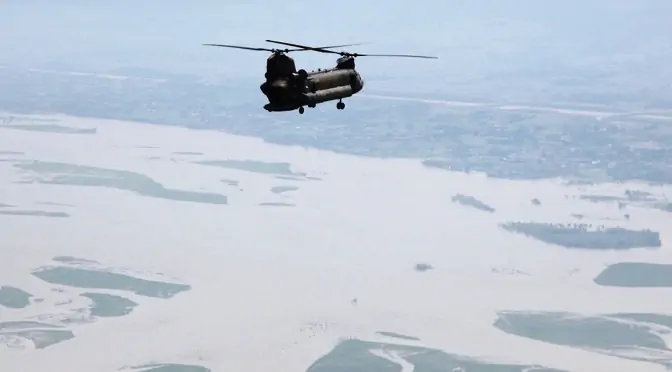
Events show that Pakistan is on the most advanced front lines of climate change. How thus should we re-read the already complex and interacting geopolitical, geostrategic and domestic situations of Pakistan and what does that mean strategically for the region and the world?
Climate of Change on the Red Sea

Since the “Arab spring” in 2011, one has seen a series of old and entrenched dictatorships topple (Georges Corm, Le Proche-Orient éclaté, 2012), from Tunisia to Yemen, or, as in Syria, being replaced by a monstrous civil war. However, the very complex political forces thus unleashed, are not only rooted in the changing social, political and religious Middle-East context. New socio-environmental dynamics have also appeared, which reveal the dire vulnerability of some of these societies, about to lose the very resources upon which they depend. So, they struggle to find new resources, or new ways and means, in a very tense strategic context. These new trends are particularly impressive around the Red Sea, where Middle-East power relations are deeply transformed by …
Continue reading “Climate of Change on the Red Sea”