

In 2013, the Kurds in Syria have their own agenda, which will determine their actions. As the other Kurdish communities in the region, their priority is to create a semi-autonomous Kurdistan where they live, notably in the NorthEast of Syria. Kurdish enclaves in Syria can also be found around Jarabulus – North – and Afrin – Northwest, North of Aleppo (Tejel, 2009: xiii). As analyzed by Spyer, their recent history tells the Kurds in Syria that mastering their own destiny is the only way to live decently and according to their own way of life, thus benefiting for once from the bounty of their land, in terms of oil and crops (Spyer, March 9 2013). The Syrian Kurds’ objective was again reasserted by Sipan Hamo, commander-in-chief of the People’s Protection Committees or People’s Defense Units (YPG – the armed wing of the Kurdish Democratic Union Party (PYD), the main Kurdish political force in Syria, see below), in a statement on 4 April 2013: “We will not bargain with any side at the expense of the Kurdish people.” (van Wilgenburg, April 5 2013, Al-Monitor).
The Syrian Kurds have already achieved an important part of their goal as they are largely the de facto main authority in regions of Kurdish settlement, notably in many cities along the northern border (see Wikipedia map below updated 27 April 2013 – yellow dots for Kurd-controlled cities – note that the map shows the latest offensive of the pro-Assad groups notably in the South).


At the beginning of the Syrian civil war, the Kurds adopted a neutral position and, starting from mid-July 2012, Assad forces began withdrawing from Kurd territories, abandoning many cities to the PYD: “In total, by the end of the month, the Assad regime had withdrawn from fourteen Kurdish cities, including the major towns of al-Ma’abde, Ayn al-Arab, Ras al-Ayn, Dirbasiyeh, as well as the Sheikh Maqsoud and Ashrafiyeh districts of the city of Aleppo.” Tanir, van Wilgenburg & Hossino, 2012: 11). Hasakah and Qamishly, however, as documented by Spyer in the case of Qamishly, remain largely under control of the Assad regime (Spyer, 9 March 2013). Spyer underlines that we are there seeing the usual strategy of the Assad regime, operative throughout the country: “Assad’s forces have conceded smaller towns and rural areas, while pushing forces into cities, like Qamishli, and holding them.”
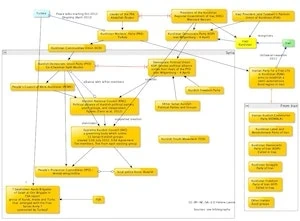
The aim of the Kurds in Syria is now to make sure they will finalize and consolidate their authority and not lose what they have accomplished because of internecine struggles either within Syria or linked to regional Kurdish issues (see mapping of the actors below – updated 4 Nov 2013 – click for a larger image), or through the incursions of other Syrian forces opposing their authorities, their values and thus not guaranteeing their right to a decent life.
The PYD is the main Kurdish political force in Syria and is linked to the Turkish Kurdistan Workers’ Party (PKK) through the Kurdistan Communities Union (KCK) (Tanir et al.: 9). Besides smaller independent Kurdish groups in Syria, its main opponent is an alliance of four political parties in Syria, funded by the Kurdistan Democratic Party (KDP), the latter being led by Massoud Barzani, who is also the President of the Kurdistan Regional Government of Iraq (KRG) (van Wilgenburg, April 4 2013, Al-Monitor). The PYD is, however, much stronger than its opponents, thanks notably to its armed wing, the YPG. Coercive forces are a crucial component of any political authority, whose strength and power depend upon the legitimate monopoly of violence and the ability to extract resources to accomplish its missions (see for further detailed explanations regarding political rule the Chronicles of Everstate).
The KPD trying to unite parties opposed to the PYD formed in October 2011 the Kurdish National Council KNC, a political alliance of 15 groups including Kurdish political parties, youth groups, and independent figures, allegedly with the benediction of Turkey (Tanir et al.: 8-9, 19). It was however unable to assert an armed force on the ground, the KPD peshmergas and the Kurdish Syrian refugees they trained remaining in Iraq (Ibid).
The fear to see Kurdish infighting derail their overarching aim, led to the Erbil Agreement signed on 11 July 2012 between the PYD, the People’s Council of West-Kurdistan (PCWK) (a previous PYD-sponsored failed attempt at uniting Kurdish Syrian groups) and the KNC, with the strong support of Barzani (Tanir et al.: 8-10, 19). Through this accord, the PYD and the KNC created the Supreme Kurdish Council (SKC), where they accept “to jointly govern the Kurdish areas of Syria” (Tanir et al.: 8-10, 19). If each party has five seats within the SKC, the PYD remains the leader through, again, its armed wing, and through alliances with left-leaning members of the KNC (van Wilgenburg, April 4 2013). Yet, some tensions linger and minor clashes between Kurds sometimes erupt, as in March 2013 (van Wilgenburg, April 4 2013).
The constitution of a de facto Kurd authority on the ground under SKC leadership with its YPG force was most probably operative in the decision by the Turkish Erdogan government to start peace talks in October 2012 with the PKK and their leader Occalan. A PKK friendly zone at Turkey’s backdoor would have indeed been potentially threatening, while escalating fighting would have been incompatible with the new regional role that Turkey seeks to achieve. The Turkish-Kurdish peace talks, if fraught with specific Turkish domestic difficulties, are progressing favourably to date (Tulin Daloglu, 3 April 2013, AlMonitor).
Meanwhile, this changed configuration favoured, on the Syrian battlefield, tactical cooperation between groups belonging to the FSA nexus and Kurds, whilst clashes beyond the Aleppo region started taking place between pro-Assad groups and Kurds (Natali, January 31 2013; van Wilgenburg, April 5 2013, Al-Monitor; Hudson, April 18 2013, Reuters). The Kurdish struggle against Global Jihadi groups in Syria such as Jabhat al-Nusra or groups supporting the creation of an Islamist state in Syria (forthcoming post) continues, as the objectives of those groups are incompatible with a Syrian Kurdistan (Natali, January 31 2013; Spyer, March 9 2013). Considering the FSA’s need to show a moderate, united and efficient face to increase foreign support (see previous article), we have here another factor for de facto cooperation between Kurdish forces and groups linked to the FSA nexus in the current strategic conditions.
The Iranian perception and consequent actions regarding the ongoing peace talks in Turkey is an element that should not be forgotten: Iran is a full player as it supports the Assad regime, as Kurds are settled on part of its territory and it is a major actor in the region. If, as suggested by Sinkaya (March 20 2013, Al-Monitor), Iran fears that PKK armed forces, freed from actions in Turkey, contribute to renew the Kurdish struggle on their own territory, then Iran’s interest would be to see those forces joining with Syrian Kurds to save the Syrian Kurdistan, assuming the YPG accept them. This might imply that Iran would support further offensive by the Assad regime in zones under SKC control. Integrating peacefully and fully future ex-PKK forces within Turkey would be a way to assuage Iran’s fear and to avoid further escalation for this specific issue.
If the strategic environment is changing and is accordingly included into the actors’ decisions, it does not mean that alliances are becoming fixed. The tactical and local situations are also crucial, while the overall conditions remain fluid. As Tejel emphasises regarding the Syrian battlefield, “We cannot state that they are ‘enemies’ or ‘allies.’ It depends on the context, the moment, and local relations. In other words, if cooperation between YPG with the FSA is now a reality, it does not necessarily mean that we are witnessing a complete rupture…. Maybe or maybe not” (van Wilgenburg, April 5 2013).
Update 26 May 2013
The SLF would have declared war on The Kurds: “a statement signed by no less than twenty-one armed groups declared ”Kurdish defense units, YPG, are traitors because they are against our Jihad.”The goal, according to the statement, is a “pending the completion of comprehensive cleansing process”, liberation from “PKK and Shabiha”. The statement was published by the “Syrian Islamic Liberation Front” – Syria Report, 27 May 2013 – “Insurgents Declare War on Syrian Kurds”.
Featured image: PYD supporters at a funeral for a local of a village outside of Afrin, Syria, who had died fighting alongside the PKK in Turkey. 20 August 2012. By Voice of America News: Scott Bobb reporting from Afrin, Syria. [Public domain], via Wikimedia Commons
* Corrects a previously erroneous location of the KDP, which is based in Iraq – Thanks to Wladimir Van Wilgenburg for noticing it and warning me.
——
Detailed bibliography and list of primary sources here.